My most-read blog entries of the year

I have to say, I really enjoyed the blog this year. After letting it go for months, I picked it up again and have consistently tried to create useful and interesting content. It’s also helped me expand my horizons and think about mental health in a different way.

This year also saw the publication of Redemptionan experience which has given me more joy than I ever could have realized – and an experience which was borne of my own depression. Take note, reader: You can get immeasurable joy out of sadness.

That being said, most importantly, I hope what I wrote has helped you.

So, here’s a look at the five blog entries I wrote which seemed to be the most popular. My year in review, if you will.

5) Ties That Bind: Liberals, Conservatives & Mental Health: This is the only “top five” entry which dealt specifically with public policy. It dealt with the challenges facing Democrats/Republicans, urban/rural areas and how mental health remains a huge challenge in all of these sections of the country.

4) Redemption, by Mike Schlossberg, is Almost Available: Alright, this one was blatantly self-promotional 🙂

3) The Tragic Suicides of Kate Spade & Anthony Bourdain: Within a few days, Kate Spade and Anthony Bourdain killed themselves. I wrote this blog entry just after the news broke about Bourdain, largely motivated by a very real fear about the contingent effect when someone does kill themselves. It was my immediate thoughts on what to do and how to help those who are suffering.

2) How To Stay Hopeful in a World Filled With Darkness: This entry was one of the most painful ones I have ever done, and like the one above, it was in the immediate aftermath of a tragedy – specifically the Tree of Life shooting in Pittsburgh. The crux of this entry was how anyone can stay hopeful and optimistic in a world where gloom and doom have become so powerful.

1) How Vacation Can Make You Depressed, and What You Can Do About It: This entry was inspired by my own upcoming vacation – and the depression which often accompanied it. What was most interesting about this one to me is that this one has seen a slow and steady increase in hits after the entry was posted back in late July. It did okay at first, but then the views just grew and grew. I suppose it’s good to know that I’m not the only one who sometimes feels this way.

It has been a wonderful year, and thank you for giving me the opportunity to talk to you. I wish you a happy, peaceful and restorative New Year. See you in 2019!

Highly recommended mental health reading

As the year comes to an end, I find myself staring at my Goodreads page. I had a pretty good year for reading! Looks like I read 28 books when I wanted to read 20 – I’ll take it!

But, that’s not what I am writing about today, at least, not specifically. I wanted to pass along the books I have read in the mental health genre, both fictional and non-fictional. Some authors just do a remarkably good job of dealing with this realm, and it’s my honor to make a few recommendations. So, without further ado:

Fiction

  • The Summer The World Ended, Matthew Cox: A fantastic book about a young girl who experiences a traumatic loss and has her entire life uprooted. The book takes a close look at trauma, PTSD and more (which I can’t get into without spoiling).
  • Consider and Contribute, Kristy Acevedo: This was the only other book I could find which simultaneously dealt with a young adult, science fiction and mental illness! In the book, portals open, with aliens advising that Earth residents jump in them because the world is about to end. The book follows a young girl with major anxiety challenges and her struggles to deal with the new world. I also interviewed the author, Kristy Acevedo, here.
  • The Memory of Light, Francisco Stork: One of my favorites. It follows a young girl who survives a suicide attempt and her way back into the light. Stork was kind enough to answer an interview from me as well.

Non-Fiction

  • Lost Connections, Johann Hari: A controversial book which I had some issues with. Nonetheless, it offers some interesting insight into the ideas of social, societal and cultural causes behind depression and mental illness in general.
  • How To Break Up With Your Phone, Catherine Price: Okay, this isn’t exactly a mental health book, per se, but I think it is. It helps people learn how to stay away from their phones, and all the benefits that can bring. I also interviewed Price on the blog a few months ago.

And, of course, if you want one more book, allow me to suggest Redemption, my young adult, science fiction tale of depression, anxiety and saving the world.

Any other books to add? Please let us know in the comments. Have a WONDERFUL new year!

Mental Heath & The Holidays

This entry originally appeared in November 2017, and for Thanksgiving, but I think the lessons certainly still apply. To all who celebrate, Merry Christmas, and Happy Holidays!

—-

Gobble gobble!

Now that the obligatory greeting is out of the way, here’s another: Happy Thanksgiving!  I hope that, for whatever struggles you are currently enduring, you are able to find a way to be grateful for all that you do have.

The holidays can be a stressful time, particularly for those who suffer from mental health issues.  This interesting article from Healthline notes two very accurate reasons for depression during this time period:

  • Social isolation, particularly during the holiday season, and particular if you actually don’t have the opportunity to spend time with friends and family.
  • Grieving.  The holidays can be very difficult for those who have lost someone, even more so if that death is a recent one.  After all, since the holidays are usually associated with spending time with people you love.  As such, the loss of those who you are close with can make the pain of the holidays feel virtually unbearable.

This story from a 2014 Huffington Post article adds some additional insight:

  • People tend to set unrealistic expectations for their social interaction and what they can accomplish during the Holidays (pro-tip: You aren’t Martha Stewart).
  • People try to do too much.
  • “Comparing your insides to someone else’s outsides,” particularly thanks to social media (YES this a thousand times!).

That being said, I may as well take this opportunity to dispel a suicide-related myth: Contrary to popular belief, suicides do not increase during the holidays.  In fact, they actually decrease.

On a personal level, I was always relatively okay during the holidaus, even at my most depressed points, though there were some rough patches.  Thanksgiving and Christmas were always nice, but, randomly, what always got me was the 4th of July.  It’s supposed to be a fun, relaxed holiday, but somehow, I always spent it alone, or frequently with people who I didn’t really like and made me feel alone.  There’s something about holidays that can just make you feel like a loser…like, you are supposed to be having fun and aren’t.  Isn’t that the worst?

So, how do you survive?  Some thoughts:

  • First and foremost, don’t even think about talking about Donald Trump.
  • Stay.  The.  Hell.  Off.  Of.  Facebook.  Seriously.  As I’ve discussed previously, social media can be really bad for your mental health, and this can be particularly true for moments when you are already vulnerable from a mental health perspective.  For your own sanity, limit your time on social media.  It will be way, way too easy to, as the note above says, “compare your insides to someone else’s outsides.”
  • It’s Thanksgiving.  Try to be as thankful as you can be.  That’s easier said, than done, of course.  But, to the extent that you are able, think about it.  If you are reading this blog, you have internet access, which is better than the more than three billion people who don’t have internet access. That likely means you live in the developed world, which means you have access to food, clean drinking water, modern sanitation systems and decent medical care.  It’s not much, but try to remember – odds are, you have it better than billions of people across the planet.  That has to count for something.  Challenge yourself to shift your perspective; yeah, you have the racist uncle sitting two seats down, and he’s had one to many Coors, but odds are still better you have it better than billions.
  • Remember – if you are able – actually relax!  The holidays were designed for unwinding.  Need a break?  Take it.  The damn turkey can wait.  You’re more important.
  • If you are someone (like me) who values routine, don’t let the holidays knock you off of it.  I’m still going to the gym.  I’m still gonna go to sleep and wake up at my usual times.  I’d recommend the same for anyone else.

This isn’t much – and it may be woefully inadequate for what you are facing, that I completely understand – but hopefully these little tips can help make your holiday a little better.

Happy holidays, readers!  I am thankful for many things in my life, and that certainly includes those of you who keep coming back to read what I have to say.  I hope you have a great holiday season, and a very happy Thanksgiving!

Depression rates by state, and what one state is doing about it

USA Today has run a fascinating and eye opening article on the state by state depression rates throughout the country.

First, here’s the basics (sorry, tried to get this as an infographic but having trouble getting the link to load):

Depression By State.png


The bluer the state, the higher the rate of depression. Leading the pack, sadly, is Utah, which has 3,977.6 cases of depression for every 100,000 people. At the bottom is New Jersey, with 2,353.3 cases. My state, Pennsylvania, is in the lower half of the country, with depression rates of 2,881.8.

The USA Today article largely focuses on the very high rates of depression in the Mountain West region of the country, which, as you can see, are very high. The article discusses the damning role of stigma, lack of access to health care, the rural natural of many of these states and high levels of gun ownership, which, unfortunately, often lead to suicide.

The article blames much of the rise of depression in this region on its self-reliant culture, particularly in terms of how it affects men. That’s one of the reasons why articles like this are so important: They can hep shatter the stigma which surrounds depression, and particularly by using personal stories of men who have suffered and sought help.

To Utah’s credit, they have done a variety of things to address their rising rates of depression and heavy rates of suicide. This includes:

  • Development of a smartphone app which can provide counseling.
  • Requiring students to take classes on life skills, mental health and substance abuse.
  • Creation of a suicide prevention research coordinator.

The App is widely known within mental health circles and has saved lives. The requirement that student take courses in life skills is interesting, particularly if it teaches things like resilience and coping skills. I know – it seems difficult to imagine that classes are now needed in this area – but the world has changed. It has evolved. And these classes are now, apparently, painfully, necessary.

This article makes a broader point: Depression, suicide and mental illness are rising. We, in the public policy arena, must address these changes for our society to have any hope of evolving and surviving. The world seems to have become a darker place. We have to be the ones who give it light.

Symptoms of depression in others

I’ve written a lot about how to deal with depression if you’re the one suffering, but there’s one topic that I realized I haven’t touched on a ton: How can you recognize when someone you know or love is depressed? That can be a challenge: The symptoms may be subtle, or they may be screamingly obvious. But recognizing that someone is suffering is the first step towards getting them the help that they may need.

So, what are the signs of depression in someone else? There’s the obvious: They seem down. They express negative emotions or feelings about themselves. But spotting depression isn’t always that easy, sadly. Here’s a few thoughts on how you can keep an eye out for when someone is down:

  • Lack of energy: The person you know or love just doesn’t seem to want to do anything anymore.
  • Social withdrawal: They don’t want to spend time with their friends, go to work or do anything other than lie in bed/stay at home and watch TV.
  • Changes in appetite: This can go either way – someone suddenly stops eating or is eating all the time.
  • Tired and/or lacking energy: Okay, yeah, we’re all busy and constantly sleepy, but if someone is complaining to you about wanting to do nothing but sleep – or not being able to get any sleep – that’s a problem.
  • Reckless behavior: People with depression will often do anything to escape their own heads. This may involve behavior which unnecessarily puts them in some sort of risk. That may involve increased use of alcohol or drugs or other dangerous activities.
  • Attention problems: People with depression may have a hard time focusing on work or school. If you see your friend having a bigger problem than usual paying attention, that may be a sign that they are in trouble.

Two additional things about the symptoms noted above. First, there has to be a baseline. Someone may seem like they are withdrawing from the world when the truth is that they are just a homebody – you have to have something to judge their behavior against, and it has to represent a change from the norm.

Second, these changes can be subtle. People with depression are often good – too good – at hiding their symptoms (trust me). This is for a variety of reasons – they don’t want to be a burden, they think it’s just “all in their head,” etc. As a friend or a loved one, this can make your life difficult, but it requires you to keep an eye out for behavior. This is particularly important when someone you know has been depressed in the past, or is likely to slip into a depressive spell again. My poor wife has a series of symptoms which she is constantly on the lookout for, and if you have someone you love who has suffered, you know exactly what I am talking about.

As always, I welcome your thoughts and comments! Anything I missed here? Please let us know in the comments below!

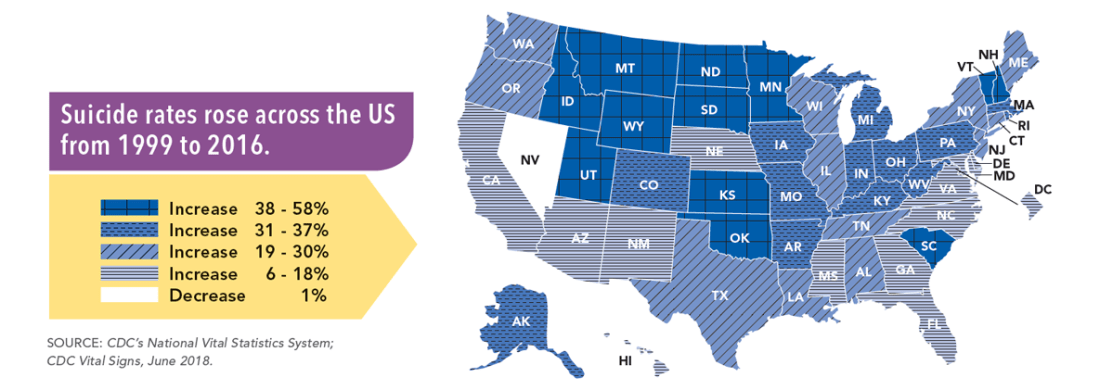
Suicide rates are on the rise

Bad news, per a press release from the American Foundation for Suicide Prevention. The CDC has released it’s 2017 mortality report on suicide and found that 47,173 Americans killed themselves – an increase of 3.7% over the 44,965 Americans who killed themselves in 2016.

The suicide rate is at a 50 year peak, an astonishingly high number, and one which is actually contributing to a decrease in the life expectancy of the average American. Suicide is the currently 10th leading cause of death in America.

The American Foundation for Suicide Prevention says that five things need to change in order to comprehensively address suicide reduction:

  1. Cultural attitudes about help seeking and overall awareness about mental health conditions.
  2. Access to affordable mental health care.
  3. Training for primary care physicians to screen for mental health and suicide risks.
  4. Reducing access to lethal means of suicide.
  5. Better data collection.

I’d add this, based on other research that I’d seen: We need a stronger social safety net. This means that we need a more activist government that can provide a social and financial backstop for people who are in need of it. Studies have shown that suicide rates are lower in areas where there is a stronger social safety net, but that connection seems to be particularly strong when there is good access to health care and housing assistance.

This is a harder one to advocate for, to be honest, and I think there are two reasons behind that.

First, the concept of a “stronger social safety net” is broader and more abstract. The five points noted above are relatively clear-cut, and the connection between them and suicide reduction is clear. I think that connection is weaker when it comes to improving the social safety net, but it doesn’t mean that the two aren’t connected.

Second – and maybe this is just in my head – is a political concern: A stronger social safety net requires more government intervention and funding. That, of course, is a much broader and more political statement, one which slants more towards the progressive end of the ideological spectrum. And that gets difficult for non-partisan organizations which typically fight for stronger mental health services.

I think that’s a long term challenge for the mental health community. Again, I’m a Democrat and pretty progressive, so I’m biased, but I do think that the research bears this out: A more progressive political orientation is better for individuals with mental health challenges and to reduce the scourge of suicide.

That is NOT to say that Republicans or conservatives don’t care about mental health or suicide reduction – nothing could be further from the truth, and I have very proudly worked with Republicans and conservatives on mental health and suicide reduction legislation. But, it is a challenge. The simple truth is that making improvements in these areas requires more government intervention.

Anyway, as always, I’m curious to hear your thoughts – do you agree or disagree with me? Let us know in the comments below!

Does social media cause depression?

Despite being a complete social media addict (sigh), I’ve written repeatedly about the negative impacts that social media can have on your mental health. However, one of the key, unanswered questions has always been this: Is the relationship casual? That is, does social media use cause loneliness, does loneliness cause an increase in social media use, or is a third item related to both?

New research indicates that the relationship IS casual: Social media use does, in fact, make you more lonely.

This comes from a new study, courtesy of Melissa Hunt, the associate director of clinical training at the University of Pennsylvania’s Psychology Department.

In her study, Hunt took two groups of college students. In the first, students were asked to use social media as they usually did (about an hour a day). The second group was asked to limit it’s social media use to ten minutes per site.

The results, per Hunt: “The main finding of the paper is that limiting your use of Facebook, Snapchat and Instagram to 30 minutes total or less per day results in reductions in depression and loneliness, especially for people who were moderately depressed to start with.”

Yikes.

Yikes yikes yikes.

This is the first study, to my knowledge, which directly shows that social media is a CAUSE of depression, not just correlated with it. However, I can’t say I’m particularly surprised by this. We know that excessive use of social media can create a variety of negative impacts on someone’s life, including cyberbullying, negative body image and more. However, this is the first time that there has been a direct casual link established between depression and social media.

What do we do? Well, that’s easy: Use social media less. Seriously. It’s good for you to do that anyway, even if this study isn’t accurate (though I intuitively think it is).

More research is needed, but I firmly believe that this study will be the first of many, many which show the devastating impacts which social media is having on our society and our culture. And it’s hard for me to say: Like many of you, I find myself completely addicted to social media. But it’s an addiction which needs to break.


The danger of Benzodiazepians

If you’ve suffered from any sort of mental health disorder, odds are good you are familiar with Benzodiazepians (aka Benzos). Benzos are a class of drugs which are used to treat anxiety and a slew of other conditions, including insomnia, seizures and more. In the short-term, they can be very helpful in getting people through panic attacks. Personally, I’ve used them in the past for rip-roaring anxiety attacks, and they can be helpful in getting through the worst of these condition. When taken in conjunction with therapy or other long-term medication strategies, they are a useful tool in treating mental illness.

Use of benzos has dramatically increased. From 1996-2013, the amount of adults prescribed benzos increased 67%, going from 8.1 million to 13.5 million. Those increases are also seen among individuals who have been prescribed opioids – and that has led to overdose issues.

According to government research, over 30% of opioid overdoses also involve benzos:

Line graph showing causes of death from opioids, benzodiazepines and opioids, and opioids without benzodiazepines between 1999 and 2015


Meanwhile, overdose deaths from Benzos have shown frightening increases of late:

Number of Deaths Involving Benzodiazepines

There is also evidence of late that shows that Benzo prescriptions for those with PTSD may increase suicide risk, and that use of Benzos may be tied to an increased risk of Alzheimer’s.

So, am I telling you to throw away your Benzos? No, no, and hell no. When used under a doctors care, and responsibly, Benzo medication can be an important part of any therapeutic regimen. Candidly, when my anxiety was at it’s peak, I walked around with tranquilizers as a “just in case.” Knowing I had those to fall back on gave me the confidence to continue my daily routine in terms of my school, work and social life. If I hadn’t had those, I would have had major difficulties functioning. Eventually, modifications to my regular medication and therapy helped me address my anxiety issues, ones which (thankfully) have not come back.

Benzos can be helpful – you just need to be careful in how you use them!

PS: GO VOTE TOMORROW!

How to stay hopeful in a world filled with darkness

This week:

I spent most of Saturday crying on and off. It’s almost impossible not to. You keep reading and hearing how the world is coming apart at the seems, how things are getting so much worse, how toxic the political environment is.

Everything does seem hopeless. I get that. But it isn’t. While world events are overwhelming, and the darkness does often seem to be closing in, now, more than ever, those of us who are capable of having and expressing hope have an obligation to do so.

If world events seem overwhelming to you, here are a few ways you can try and draw some hope.

First: Concentrate on the good in the world, not the evil.

As it happened, the day of the Pittsburgh shootings, my family and I were going to an open house at a local Mosque. I did this Facebook live video while I was there:

The conclusion is this: Evil is loud. Good is soft. But there is still more good than evil. In the aftermath of the Pittsburgh shootings, hundreds rallied for peace. Pittsburgh blood banks put out a call for help after the shootings and were overwhelmed with donors. First responders did their job that day, heroically running into the Temple, and likely saving lives while doing so, even while four of their own were injured.

The world may seem broken, but that’s because evil screams and gets more attention. Don’t concentrate on that. There is so much good in this place. You don’t even have to look very hard.

Second: Find what you can control, and do something about it.

One of the hardest lessons for me in government and politics has been learning the limits of governmental power. And no, I don’t mean that in the sense of wanting government to be able to do more. I mean acknowledging that there are simply some things beyond our control. You get into government and politics because you want to help people, and then you realize that you can’t save everyone.

What all of us can do, however, is make a difference in certain areas, and that’s what I am referring to. What are you good at? What are you passionate about? Concentrate on that, not on all the evil in the world. Find where you can make a positive, tangible difference in someone’s life. For me, that’s been mental health and other areas of government and pubic policy I am passionate about. For you, that will almost certainly be something different, but find what it is and go for it.

Don’t give into the hopelessness. Find where you can make a difference, and make it.

Third: It’s okay to unplug and take care of yourself.

You can’t do good without taking care of yourself. Unplug for a few hours or a day or two. It’s okay. Don’t feel guilty. And if that guilt becomes overwhelming, remember: You’re no good to anyone if you burn out.

Fourth: Draw solace from the fact that there are millions of others like you.

I’ll refer you back to the blog entry I wrote a few weeks ago: Millions upon millions of Americans are deeply worried about the world in which we live. That doesn’t change the world, no. But it does create a base of people who agree with you – that things are scary, and that we have to work to make the world a better place.

Finally: Remember the arc of history.

Despite it all, humanity has made more progress in more areas than any of us could have ever dreamed. Progress is not inevitable. It zigs and zags. But, with the concentrated effort of a dedicated world, it does come. Concentrate on that, focus your efforts on the forward momentum of humanity, and we will be okay.

Using Facebook to diagnosis depression

I came across this article in Medical News Today, which reviews a study done in the medical journal Proceedings of the National Academy of Sciences. To make a long story short, the study reviews Facebook data and medical records, analyzing information posted by the more than 100 people who had been diagnosed with depression.

While there is ample evidence that social media can be a cause of depression (I have written about the topic before), this is the first time that I have ever seen published information which notes that social media can be used as a diagnosis tool for depression. That has some pretty interesting implications.

First, the study itself. Here’s one of the most important parts:

The scientists fed the information into an algorithm. In total, Eichstaedt [author of teh study] and colleagues analyzed 524,292 Facebook status updates from both people who had a history of depression and from those who did not.

By modeling conversations on 200 topics, the researchers determined a range of so-called depression-associated language markers, which depicted emotional and cognitive cues, including “sadness, loneliness, hostility, rumination, and increased self-reference” — that is an increased use of first-person pronouns, such as “I” or “me.”

The researchers found that the linguistic markers could predict depression with “significant” accuracy up to 3 months before the person receives a formal diagnosis.

Here’s a look at what words can be used to predict depression (none of this will be a surprise):

F4.large

Also notable is that more self-referential language is found more often in people with depression. That’s not really a surprise, as depression and narcissism are often linked.

To be perfectly honest, none of the above should be very surprising. Extended use of terms that indicate pain, distress or rumination would obviously indicate someone who is in a crisis. What is interesting, however, is that you can actually use these terms on social media to predictably and reliably diagnosis depression. That, to me, is fascinating. It is yet another tool in the toolbox for diagnosis depression, and as numerous studies have shown, depression remains massively under diagnosed, with some estimates showing that up to 2/3 of all individuals with depression are undiagnosed.