The American Public Gets It: Stigma Is Real, and We Need To Do More

CBS News ran this fascinating poll on mental illness. I’d argue that there aren’t many surprises in the poll, but I got two key takeaways.

First, to summarize the findings:

  • 51% of Americans say that people living with a mental illness face “a lot” of stigma and discrimination – 31% say “some.”
  • 38% of people say that mental illness stigma has gotten better, 22% say worse, and the rest say that it hasn’t changed.
  • 66% of people say that mental illness is a very serious public health problem – 28% say somewhat serious.
  • People do believe that mental illness is a real medical condition (79%). Roughly 2/3 of those polled also said that virtually anyone can get a mental illness and most people who are treated right can lead productive lives.
  • A mere 12% of people say that services for the mentally ill are adequate – but 49% said they are not.
  • A whopping 77% of people say that celebrities speaking about mental illness are doing a good thing – only 18% said no.
  • 73% of Americans know someone diagnosed with a mental health disorder (I guarantee that number is higher and people just hid their own mental illnesses), while 58% said that they had a family member who sought care for mental health (again, I’m sure that number is higher).

So, here’s what I got out of this. First, those support numbers are just overwhelming. 66% of people think mental illness is a “very serious” public health problem. 28% say it is at least “somewhat serious.” That’s 95% of the American public who think that mental illness is at least somewhat serious. That is not a small number! The key question is this: What does that translate to? Are people willing to dedicate more time and money to mental health care? Or is this simply a, “Gee, that sucks…moving right along” sort of things?

At the bare minimum, it is good to know that people understand just what a major problem mental illness is.

Second, the stigma questions got me thinking: What if the stigma is all self imposed? I mean, take a look again at that top finding. 51% of people think individuals with mental illness face “a lot” of stigma, while 35% say they face “some” stigma. That is not a small number. But if that many people think stigma is so real, what’s really the problem here? People who acknowledge stigma is real must also have stigma-inducing thoughts, right? Or, what if the stigma is just the fear of being stigmatized? Or self-stigma? I’ve always thought that self-stigma is a bigger problem then actual stigma.

The findings, in my mind, mean that we have to rethink our traditional definition of mental health stigma, because I don’t think that a traditional understanding of, “People with mental illness sure do face a lot of stigma” is enough.

But, as always, I ask: What do you think? What are your thoughts on this poll? Let us know in the comments!

The Mental Health of our LGBTQ Friends

We celebrated National Coming Out Day last Friday, and it gave me a few things to think about. As we all know, this world is hard enough. The times we live in are more interconnected, more stressful and more difficult than they ever have been, and I do think that the current state of our world is adding to our rising rates of mental illness and suicide.

So, imagine being someone who so many in society say is wrong.

I’m a straight, white man. This comes with many societal advantages. And let me be clear, I cannot imagine how difficult it must be to be a sexual orientation that is different.

But numbers don’t lie: It’s a harder life. A quick look at the statistics:

  • 28% of all LGBTQ youth said they felt depressed most of the time (in the past 30 days), compared to 12% of non-LGBTQ youth.
  • When compared to non-LGBTQ youth, LGBTQ youth are:
    • Twice as likely to feel suicidal.
    • Four times as likely to attempt suicide.
  • Over the course of their lifetime, 30-60% of LGBTQ people deal with depression – 1.5 – 2.5 times as straight individuals.
  • These issues are largely impacted by perceived support and social stigma.

So, what can we do to help individuals who identify as LGBTQ? A few things. First, remember, all language counts. If you show bias towards one group, individuals are far more likely to perceive you as biased towards another. Don’t be that person who uses bias and then jumps in with, “But I have a gay friend!” Don’t show bias in your language. Don’t use derogatory terms to discuss anyone. Language counts. Language reinforces stigma and stereotypes. Use appropriate pronouns. Use language that is kind and respectful. And just…don’t be an ass.

Second: Show your support. You don’t know who is struggling or who is desperate for someone to talk to. One study which was bouncing its way around my Facebook feed showed that an LGBT individual who found a supportive adult could see their risk of suicide drop by 40%. Be that one person. And be so explicitly. Yeah, post something to your Facebook page about how you support LGBT people and you’re a safe person to come out to. Is it gonna get anyone to come out to you? Maybe. But, more importantly, someone who is LGBTQ will see it, and will appreciate it. They will know that you value them as a person. That you believe in their dignity and basic human rights.

Third: Support policies which humanize LGBTQ people. In most places in Pennsylvania, you can be fired or evicted for being gay. That’s madness, and laws matter: When gay marriage was equal in only some states, studies showed that LGBTQ people had better mental health and lower rates of addiction when they lived in states where gay marriage was legal. Again: PUBLIC POLICY MATTERS. It makes a difference! Support your LGBT friends by supporting candidates for office who support human dignity for all.

Others who are better versed in this subject have written about it, and I encourage you to read more about how to help millions of Americans feel loved and safe. I can’t imagine how hard it must be to be a minority in America – particularly today, given that the President is a racist, xenophobic monster who stirs up hatred at anyone he can find. That being said, I remain convinced – now more than ever – that this is the moment to show our friends – all of our friends – the love and respect they deserve. Be that person. Be one of the people who tells our friends that they are loved. You may save a life.

3 Unexpected Things Which Are Linked To Mental Illness

We all know that there are some things which correlate positively with mental illness: Stress, negative changes in economics, etc. But it’s more than that – and it’s some areas which you probably wouldn’t expect.

So, here are a three random items – well, seemingly random items – which are correlated with mental illness.

And a reminder straight out of Statistics 101: Correlation does not equal causation. Two items being linked doesn’t mean that one causes the other.

1) Air Pollution

I stumbled across this one while looking at the news, and it really surprised me, but here goes: Air pollution in children is positively correlated with worse psychiatric disorders, according to a study from Cincinnati Children’s Hospital Medical Center. The study also noted that already existing research had already established the connection in adults. So, as if we needed another reason to reduce air pollutions (besides all the asthma and death and climate change), here’s more. And, because life is deeply unfair if you’re poor, the study also found that the worst outcomes were reserved for kids who lived in disadvantaged neighborhoods.

2) Childhood infections

This one is, admittedly, not one I would have expected but when you think about it, it sort of makes sense.

According to a 2018 report, researchers in Denmark found links between certain infections and some mental illnesses, like depression, bipolar and schizophrenia. The theory here is that certain infections can activate the immune system. This, in turn, caused certain mental illnesses to set in.

This wasn’t a small study, either – it tracked 1.1 million Denmark children born over a seven year period.

3) Brain inflammation

I’ve actually discussed this one before, but there appears to be a connection between inflammation and depression. As noted in the link above, there is some research to indicate that anti-inflammatory drugs may be able to help reduce symptoms of depression.

Further research and writings have indicated that it is possible that inflammation is at the core of many physical and mental illnesses. As such, treating brain inflammation may be critical to reducing depression, anxiety and a whole array of other psychiatric disorders.

I’d actually argue that the brain inflammation one is the most interesting here. Why? Because the last article highlights just how much we know now compared to what we thought we knew years ago – and, of course, we will likely repeat that observation in the next ten years as well. What else will we learn? Will we be able to specifically engage in gene therapy to fight off mental illnesses? What kinds of treatments will evolve? It’s a fascinating question.

As always, I’d love to hear your thoughts in the comments below!

Work, Work Hours & Mental Illness

I have frequently discussed the importance of examining other real-life factors, such as economics and housing, as we discuss reducing mental illness and suicides. Well, here’s a great article on why: A new study directly ties shift work and varying hours to depression. From the article:

In particular, the study found, shift workers were 33% more likely to have depression than people who didn’t work nights or irregular schedules.

Shift workers also had a higher chance of developing anxiety, but in this case the difference was too small to rule out the possibility that it was due to chance.

Women appeared particularly vulnerable to the negative mental health effects of shift work, researchers report in the American Journal of Public Health.

Compared to women who worked consistent weekday schedules, women who worked nights or split shifts were 78% more likely to experience adverse mental health outcomes.

The article was based on a report which examined seven studies, totally 28,438 participants. It specifically blamed this increase in depression and anxiety to a disruption of sleep; the connection between a lack of sleep and mental illness has been well documented.

This, obviously, is not the only study which ties work challenges to mental illness – or economic trouble in general. When unemployment increases, so does depression and suicide. Increases in foreclosures and evictions are directly tied to increases in suicides, and states which increased their minimum wages saw slower growth in suicides than states which held their minimum wages even.

This goes back to one of the points I have hit on this blog and in my advocacy over and over again: Mental illness is not always about mental health. It’s myopic to make such an assumption. As we talk about reducing mental illness, we have to talk about increasing the social safety net, about making sure people can get good jobs for fair wages, about giving people a chance to recover from economic hardship. And yes, this unquestionably informs my politics.

The working poor are not more likely to have mental illness or die by suicide than the economically secure, but suicide increases in both groups when there is a change in economic status. We can’t necessarily stop someone’s economic situation from turning south, but we need to at least make sure that everyone has the resources in place to give them a chance to recover.


Stigma, Shame & First Responders

My mental health and legislative worlds frequently come together, but an article and what happened yesterday really made me blink.

First, the good news. At a hearing yesterday, the Pennsylvania House Veterans Affairs & Emergency Preparedness committee moved a bill of mine. HB1459 would give first responders more mental health resources. It would require trauma and mental health training, create a peer to peer mentorship program and mandate the creation of a toll-free hotline for first responders who are struggling with mental health issues.

I feel like legislation like this is more important then ever. Why? Stories like this, which report on the NYPD’s ongoing mental health and suicide crisis, and the unwillingness of some police officers to seek mental health help, despite the fact that they feel the need to do so:

In a new report, the Department of Investigation’s Office of the Inspector General surveyed officers who retired in 2016 and found that 25 percent of them reported going through a period of emotional stress, trauma or substance abuse that caused them to consider getting professional help.

But more than a third of those officers did not end up seeking assistance, according to the report.

Half of them expressed fear that the department would find out about their decision to seek support.

So, what do we do here?

First, there are internal things that I think the NYPD can do. Chief among them? Work to change the culture and attack stigma by sharing stories of successful police officers who have experienced mental illness, sought help, and thrived.

Furthermore, the NYPD must do whatever it can to stress the confidential nature of their programs. According to the report, 50% of people surveyed were worried about the department finding out about their illnesses, 45% of negative labels, and 39% afraid of being put on a modified assignment. As the NYPD notes, an “extremely small number” of officers do wind up having their weapons taken away, but they are given those back upon successful treatment. Treatment is confidential, except in cases where the officer in question may present a danger to themselves or others.

The second is broader: We need cultural change at a society wide level. When we discuss the importance of stigma when it comes to mental health, this is why. Stigma is more than just how people look at the mental ill, its how we look at mental illness within ourselves. Clearly, as cases like this demonstrate, a culture of machismo and an overabundance of self-reliance can kill. For reasons like this, we clearly must do a better job of reminding people that there is no shame in seeking help, and that in many cases, its the only way to lead a happy, healthy and productive life.

More Than Stigma: Shifting the Nature of the Conversation Around Mental Health and Suicide

Advocates for suicide prevention and mental health often talk broadly about “the stigma” which surrounds mental illness and suicide. Many of us – myself included – believe that if we can just get more people talking and thinking of mental illness, if we can have people discussing their issues with depression, anxiety, addiction and more without shame or fear, we can help to put an end to this epidemic. I firmly believe that this is the case.

I also know its not enough.

And that’s where the conversation around public policy, resources and taxation has to come into pay.

I happened to catch a fascinating column on mental health the other day – I obviously can’t find it now, that would be too easy, but the column made a great broad point: Ending mental health stigma is like cutting holes in a wall, but then there’s nowhere to go because our system of mental healthcare is so broken in this country.

Many of us concentrate our efforts on stigma for a couple of reasons. I think it’s one of the most important things that we can do. But let me expand on the second part of that sentence: That we can do. People do need to know it is okay to seek help and to treat themselves. They need to know that these issues are real, powerful and can kill you. But, as any studies have shown, individual conversations are the best way to break mental health stigma. A face to face talk can make a huge difference in that area. That means that, without question, the most important person to ending mental health stigma is you.

Second, it’s the easiest.

Making society-wide change is really hard, of course. Particularly in areas where colossal interest groups are at play. I’m an elected official – theoretically one of the people who makes state-wide decisions in Pennsylvania – and I fully understand just how difficult this can be.

And the simple truth is that we must make systemic changes to help reduce rates of mental illness and suicide.

From a mental health and suicide perspective, there’s an awful lot that needs to be done. This includes increasing access to mental health care, increasing the number of mental health care practitioners and addressing the mental health care practitioner shortage, reducing costs, enforcing parity in insurance care, reducing access to deadly means of suicide and more. And that’s to say nothing about the major societal problems that we face which contribute to mental illness and suicide, including improving housing options, strengthening the social safety net, increasing the minimum wage, making housing more affordable, etc.

Many of us tackle stigma because we can’t get at these issues. And stigma is something we can control.

So, what does that mean? Should you stop talking about mental health stigma? Hell no. Of course it’s vitally important, but it’s important in more ways than you think, because the more you discuss mental health, the more pressure you can bring on policy makers to address the fundamental inequities and gaps in our system which allow for mental illness to run so rampant. Keep fighting.

But make sure you fight in a public policy realm, in addition to addressing individual changes. Tell policy makers and elected officials that you expect them to do more to address rates of mental illness and reduce suicides. These issues require government intervention, and that requires public pressure. Please help make this happen.


Medication is Not Addiction: A response to a misinformed column

I spent way too much time on Sunday on Twitter, joining a chorus of voices who were yelling at David Lazarus, a columnist or the Los Angeles times. Lazarus wrote a column in which he discusses his own experience at trying to withdraw from anti-depressants. The title of the column? “Hi, I’m David. I’m a drug addict.”

Yep. Only went downhill from there.

Ironically, Lazarus discussed important issues like the over prescribing of medication, failure to adequately warn patients about side effects and discontinuation syndrome. These are real, important issues. They merit serious, thoughtful consideration. Instead, Lazarus decided to call millions of Americans (like me) drug addicts. He esoterically wondered “Who am I, really?” about taking anti-depressants. It’s a tragic, misguided view, one which reinforces stigma and will prevent people from getting help they need. And the language used by Lazarus is just appalling. If I’m a drug addict, so is everyone else who uses medication to survive for any other condition.

Really, this is just an ugly article.

I wrote a response which the Los Angeles Times did not accept, citing their policy to not run op-eds in response to other op-eds. Fair enough. My response, then, is below.

Don’t believe crap like what Lazarus decided to spew. Medication can be a vitally important part of any therapeutic regimen. It has saved thousands of lives.

Let’s say you are a diabetic and require insulin to live. One day, a friend tells you to quit insulin. Stunned, you ask why. Your friend responds: “Well, you can’t live without insulin. That makes you a drug addict.”

That’s absurd, right? Taking a prescribed medication in recommended doses doesn’t make you a drug addict. That makes you a responsible adult.

But the above scenario would never really happen, right? No one would ever claim that taking medication to treat diabetes, Parkinson’s or Alzheimer’s would make you a drug addict.

But, apparently, such an understanding does not apply to the millions of Americans who take medication to manage mental illnesses. To Americans like me.

For eighteen years, I’ve been diagnosed with a major depressive and generalized anxiety disorder. I’ve been suicidal. The medication which I take, in conjunction with therapy and lifestyle changes, has saved my life.

About five years ago, I made the decision, as a Pennsylvania State Representative, to start discussing my battles with depression, anxiety and suicidal ideation. I did so in response to the stigma which surrounds mental illness. Depression isn’t a weakness. It can’t be willed away. Taking medication doesn’t say anything about one’s character any more than having heart disease indicates a moral failure.

That’s why I was so disheartened to read Mr. Lazarus’ column: It took serious issues like over-prescribing  and discontinuation syndrome – issues which deserve thoughtful, reflective discussion – and conflated them with drug addiction. To be sure, medication is not a panacea. It often takes months, if not years, to find appropriate medication and dosage. Prescribers sometimes fail to appropriately monitor their patients. Side effects are real and dangerous. All of these issues demand thoughtful consideration and conversation.

However, such problems exist in virtually all areas of medicine, and no one would reasonably or seriously suggest that we should stop prescribing scientifically proven medication to people in need. Yet, that is exactly what some suggest when it comes to mental health.

Mr. Lazarus refers to himself as a “drug addict” for taking anti-depressants. Yet, he also discusses being a diabetic who takes medication for chronic Type 1 diabetes. Strangely, he declines to refer to himself as a “drug addict” for requiring insulin to manage his blood sugar levels. I wonder why.

We should never, ever be so foolish as to conflate appropriate use of anti-depressants with drug addiction. To do so makes people who take anti-depressants to live sound like sound like a caricature of a drug addict, desperate for their next hit of smack…or, as I like to call it, the pills which help me not want to kill myself every morning.

Contrary to what some believe, anti-depressants are not happy pills which whisk you away on a cotton-candy cloud, carrying you to Lollipop Island to float with gumdrops all day long. What they do is help you control symptoms, improve your mood and make other forms of change – like psychological therapy and lifestyle changes – easier to obtain.

Taking medication for mental illness doesn’t change who you are. It allows you to be who you are.

Far too many Americans have ignored their own minds and medical advice, choosing to try and “tough out” spells of depression, to “man up” or ignore these painful and rehabilitating symptoms. Too many Americans have powerful fears that taking anti-depressants makes you weak. This stigma must be crushed and rebutted in the same way intelligent society has pushed back on those who attack vaccines.

Anti-vaxxers and those who deny the positive impact of anti-depressants are flip sides of the same coin: They seek to use pseudoscience and stigma. Science has given us incredible tools which can be used to our great physical and emotional benefit. To ignore those tools, or to somehow wrap their use in shame, serves only to pull us into a darkness which we should have left behind decades ago.

The nearly 1 in 5 Americans who suffer from mental illness – including me – deserve to have our challenges discussed with respect and a comprehensive understanding of mental health treatment options. This discussion is simply incomplete without discussing the importance, effectiveness and risks of medication. No one who takes an anti-depressant is a drug addict, any more than a person who takes Prilosec for heartburn is addicted to not having their chest feel like is on fire.

The facts are stark. Depression rates are skyrocketing, rising sharpest among today’s youth, who have seen nearly 50% increases in rates of depression. 47,000 Americans – and 2,000 in my home state of Pennsylvania – died by suicide last year, an increase of 34% since 1999.

We need serious, sober conversations about mental illness and how to treat it. There are many concerns with anti-depressants. These are valid, serious concerns which must be addressed. But these conversations must occur using words and arguments which shatter stigma and support science. To do otherwise does an incredible disservice to those of us who suffer.

 

The news isn’t completely terrible: 3 Reasons to be hopeful in our ongoing mental health crisis

I’ve written a lot about just how bad things are in the universe of mental health. Rates of depression and anxiety illness are rising, particularly among our youngest and college students, and suicide rates are hitting highs which haven’t been seen since World War II. This, of course, is terrible.

Still, life could be a lot worse when it comes to the mental health universe. Here are three reasons to be hopeful in the long-run.

Stigma is decreasing

According to multiple articles, the stigma which surrounds mental health is slow decreasing, but particularly for those who are younger. Many in a younger generation view seeking therapy and getting help as normal – as such, they don’t hesitate to do so. All of these articles note – correctly – that will still have a long way to go before we can consider stigma to be truly “defeated,” but it is worth noting and celebrating that significant progress has been made. Furthermore, the slew of celebrities who have openly discussed their own struggles has furthered humanized the issue and made others realize that suffering from mental illness doesn’t have to hold you back.

The Affordable Care Act is Helping People Get Treatment

The ACA – or Obamacare – has been subjected to no shortage of controversy. However, some things about it are indisputable. One such example is that more people are getting the mental health treatment that they need and deserve – and that they are getting better. ObamaCare required that all individual and small coverage plans offer mental health care, and that the coverage of mental health be similar to what it was for physical coverage. This alone has helped to increase the amount of plans which offer mental health care. The percentage of young people without health insurance dropped from roughly 22% (2013) to 13% (2016), and since young people were more likely to first experience a mental health challenge, this meant that more people had access to the care that they needed.

There’s more, of course. States which expanded Medicaid saw sharper decreases in mental illness than states which hadn’t, resulting in more care, more treatment and a lower financial burden.

There is no doubt: ObamaCcare has helped those with mental illness.

Social Media Has Tremendous Potential For Good

Alright, so I’ve been a bit harsh on social media in my time as a blogger in the mental health world. Just a bit. But it really isn’t all bad. Social media has the potential to be very helpful – and indeed, has been very good for mental illness…if used properly.

Social media, even if it’s just digital, can help promote a sense of connectedness. Sufferers of various mental illnesses can connect with more people and find the assistance that they so desperately need. If it’s users are mature enough, they can provide goals to aspire to and help to push creativity. By keeping users abreast of social opportunities and events, it can help maintain social relationships.

Indeed, for all of the negative press which social media has gotten on mental illness, there is at least one study (which examines adults, not just college or high school students) which shows that it can be positive and result in less psychological distress.

All kidding aside, I think social media can be good for metnal health…but requires literal mental training that I don’t think we possess as of yet. People have to use social media to supplement their social life, not supplant it. They need to recognize that it’s a curated form of life, not real life. And they need to remember that they have plenty of things to feel joyful and proud about, and to not feel jealous of what others put on their newsfeeds. That can be a real challenge, to say the least!

As always, I’d love to hear your thoughts. What else has been good news in the world of mental illness? Let us know in the comments below!


Does hypnosis help – long term – with depression and anxiety?

All of us who suffer are constantly on the lookout for alternative ways to cope with depression and anxiety. As I was putzing around on Facebook the other day, the thought occurred to me: Is hypnosis one of those methods?

I’ve written in the past about the benefits of trying to relax throughout the day. One such way I’ve done so is by listening to ASMR videos, even if they are just running in the background. I’ve also always found guided relaxation videos/tapes to be very calming, and again, that sort of inspired this particular entry for me.

First, let’s review what hypnosis is, and what it isn’t. Hypnosis will not make you cluck like a chicken. It will not train you to become an assassin. It will not make you do anything you don’t want to do.

Hypnosis – true hypnosis, not the exaggerated, movie kind – is defined as heightened concentration, focus and openness to suggestions. While it is often associated with going into a state of deep relaxation, it is not to be confused with going into a coma-like state. Hypnosis patients are fully aware of what is going on, they are just put into a more relaxed state.

I did a little bit of digging about the available research when it comes to depression, anxiety and hypnosis. Healthline refers to hypnosis as a “complimentary therapy” which can be used to treat depression with minimal side effects, but cautions that it shouldn’t be the only type of therapy which a person uses. WebMD does the same, while noting that hypnotherapy can be used for the purposes of suggesting new (and more productive behaviors) or analyzing past traumas. However, both pages noted that hypnotherapy can be associated with the process of implanting false memories – as such, it should be avoided by people who may be sustainable to those, like individuals who suffer from dissociative disorders. Meanwhile, the Anxiety and Depression Association of America goes more in-depth in terms of how hypnosis can compliment cognitive behavioral therapy, describing how hypnosis can be used to generate images about what someone wants or needs.

In terms of specific research, I found a couple of papers. One 2010 study noted that there was a relative “dearth” of actual research on hypnosis’ effect on depression and anxiety, but that it was easy to imagine, conceptually, how hypnosis could be helpful for these disorders. Most interesting is a 2016 study, which made the rather startling claim that hypnotherapy was actually more effective than Cognitive Behavioral Therapy. That’s…interesting. It’s a finding that I’d argue would have to be replicated in order to be believed, but that’s quite the claim!

If nothing else, again – I think hypnotherapy can be deeply relaxing. Guided imagery (a process similar to hypnotherapy) can be effective for relaxing and for stopping anxiety attacks in their tracks. Heck, I remember my therapist once designing a guided imagery recording for me. So yeah, I think hypnotherapy can be useful – when done by a licensed therapist and in conjunction with any other medical professional you may have.

What about you – any experiences with hypnotherapy, positive or negative? Let us know in the comments!


The disproportionally high levels of suicide among (some) minority groups

It’s been written repeatedly, and it’s true: One of the most likely demographic to die by suicide are middle aged, white men. But, as a recent report in USA Today helps illuminate, we shouldn’t confuse this reality with the notion that white men are the most at risk – or that other groups don’t need very real assistance.

USA Today’s story, which was published earlier in the week, came with this stark headline: Suicide Rate for Native American Women is up 139%. Native American and Alaska Natives have a suicide rate 3.5 times higher than the lowest group – an astonishingly high number.

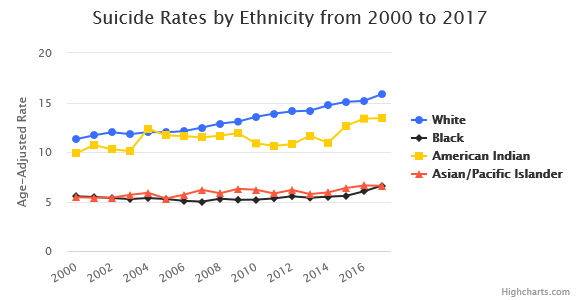
The story highlights a very, very ugly truth: In mental health – just like in health care generally speaking, unfortunately – minority communities have it worse. But, in the case of suicides, not every minority community is this way. For example, suicide rates among African Americans and Pacific Islanders have increased, but remain roughly half the rate of suicides as whites, according to the American Foundation for Suicide Prevention:

suicideRatesByEthnicity.png

Meanwhile, according to the Suicide Prevention Resource Center, rates of suicides among Hispanics also remain far below the United States average, with Hispanics dying by suicide at a rate of slightly more than half of the rest of the United States population.

This is good news, of course, and a very rare bit of good news when it comes to health care for black and Hispanic communities. What drives these rates lower? There are many theories, primarily the idea that strong family and community support provide a degree of resilience not available in other cultures, as well as the idea that self esteem and religiosity rates are higher among African Americans.

All of these factors may tie into why other minority groups have higher rates of suicide. LGBT community members are three times more likely to die by suicide. On average, LGBT members as well as Native Americans, have lower levels of self esteem, community support and family bonds.

In total: The minority suicide rates are not what they would reflexively seem to be. That’s something for all of us to keep in mind as we deal with public policy and suicide.