From The Mighty: The Power of a Public Life

If you are someone who follow’s websites that deal with mental illness, odds are good that you have heard of The Mighty. It’s a website that features stories on mental illness, disability and more, and allows people a chance to express themselves and read/learn about the struggles of others. I’m pleased to say I just had a story I wrote accepted and published there – you can find it here.

The general crux of what I wrote is this: There is a power in living a public life with who you are, and not hiding your mental illness anymore than you would a physical one. I have found this time and time again – the openness in which I live my life has made it a better one, and it’s not just because I’m a public official – it’s because I don’t give a damn. Hiding who you are takes too much energy. Telling the world who you are is beyond freeing. Trust me on that.

Anyway, here’s what I wrote. Enjoy!

Well, let me start with a bit of a confession: My job requires that I talk about myself a lot. It’s something I’ve never quite been comfortable with, but, well…sucks for me.

Let me add a second confession: The title of what I wrote – “The Power of a Public Life” – means two different things.

And, a final confession, since I believe in being totally honest (again, despite my full-time job): I’m writing this in part to talk about a really public portion of my life. Now that the confessions are out of the way…

Hi there. My name is Mike Schlossberg. I’m 34 years old and lucky enough to be married to a wonderful woman, Brenna. We have two wonderful children: Auron (7) and Ayla (5). Bonus points if you know the origin of the names.

So, what makes me a little different? Well, three things. First, I’m a full-time elected official. I have the great privilege of serving as a Pennsylvania State Representative for the people of the 132nd Legislative District, representing parts of Allentown and South Whitehall township. I’ve had this job since 2012.

Second: I live with major depressive disorder and generalized anxiety disorder. I have all my life.

And third, which you probably figured out: I’m very, very honest about my struggles.

That wasn’t always the case. I never really hid who I was, per se, but I never talked about it openly.

That changed with the suicide of Robin Williams.

Like many of you, I mourned his death, and wondered how a man with his resources and force of personally could ultimately lose the fight against his demons. On the day his suicide was announced, I was putzing through Facebook, and came across this status: “So sad Robin Williams committed suicide. Shame he didn’t have enough faith in Jesus!”

My damn head almost exploded. How could someone be so ignorant? Did people really think this way? Apparently, given the guy’s statement and all the “likes” it had, yes.

So, I decided it was time to tell my story, and wrote an op-ed in the Morning Call, my local paper. You can find that here. In it, I detailed my own struggles with depressionanxiety and suicidal ideation.

Since then, I’ve done more. I cofounded and cochair the Pennsylvania Mental HealthCaucus. I spoke about my own challenges on the floor of the House of Representatives. I’ve appeared in PSAs and spoken at countless events. Legislatively, I’ve fought for funding increases and introduced legislation to help poor mothers get access to treatment for postpartum depression, as well as reduce suicides.

To my pleasant surprise, telling my story was… well, to be honest… an amazing boon for my career. I was so angry when I wrote the op-ed that I didn’t think of the political ramifications. I was floored when people began to call my office to say, “I have depression too,” ask for advice or just say thank you. I won awards and accolades from across the state. I don’t mention this to boost my own ego, but to make a point: Living a public life wound up being the best thing for my career. It’s my trademark issue. People want that — they want to see people for who they really are, not just their public face. I have this theory: Deep down, everyone wants a real person. They don’t want the mask. And if you are brave enough to show who you really are, they’ll be grateful.

That being said, as incredibly fulfilling as my job can be, I found myself wanting to do more. In 2014, I went through a particularly rough patch. I’ve always had a hobby: I write. And, during the worst of this bad spell, I decided that I wanted to write again as a form of therapy. I went with a young adult, science fiction plot about a group of teenagers who get put onto a spaceship and have to save the world. The twist: The main character suffers from depression and anxiety. Sound familiar?

To my pleasant surprise: The book is being published on June 5. “Redemption” is available here.

So. Back to my point. My job requires I live a public life. Every success and every mistake — and believe me, I have made them — are for the whole world to see. The ultimate anecdote to that? Pure, unadulterated honesty. Even with my so-called “flaws,” like the depression and anxiety that periodically rear their ugly heads. I’m still in therapy. I’ve taken medication every single morning from 18 on, and I talk about that all the time, because I want the world to know who I really am. I have publicly said I don’t think I’ll ever “get over” my depression — recovery is a journey, not a destination. I will always struggle.

But I’ll do it for the whole world to see. That honesty — that willingness to live a public life – is beyond freeing. In a very public job, the whole world knows who I am.

My point is this: Embrace the freedom that living a public life can bring. And help others show the rest of the world who they really are.

New study links social media and depression

I’ve written about it before, and now there is even more proof: A new study has linked social media and depression

I caught this article in Forbes, which notes:

The team calculated that for every 10% rise in negative social media interactions a person experienced, their risk of depression rose significantly—by 20%. For every 10% rise in positive experience, risk for depression fell by 4%; but this association was not statistically significant, meaning it could have been due to chance.

Lovely. In other words, negative experiences on social media can make us depressed, and they far outweigh the positive ones. Why? According to the conclusion of the study, this is because of “negativity bias” – meaning that people are more likely to remember and feel negative experiences, rather than positive ones.

I don’t need to go on too long of a rant, I think, about the serious dangers of social media when it comes to our fragile mental health. The connection is clear, albeit not in a causational way just yet (there needs to be more research to determine if people who are prone to depression are more likely to use social media, if social media really does make people depressed or if there is a third factor linking the two).

That being said, I think it is extremely clear that social media and technology, for all their strengths, can have an absolutely devastating impact on our mental health. I legitimately wonder if, decades from now, we’re going to look back on this period as a turning point in our society, one where we first truly began to deal with the psychological dangers of society, or continued to allow it to eat us alive.

I’m pretty young – only 35 – so it’s not as if I have the memory or expertise to analyze how each technological impact benefited and hurt society. I suspect that the answer is both. However, I think that the reason that these changes seem so much more pronounced and ubiquitous is because the technology has evolved too. Phones never leave our side – they are often the first and last things we touch during the day, and we spend hours staring at their tiny screens, searching for connection and fulfillment that will never really come. They are everywhere, and so is their impact.

That, I think, is why these changes seem so much more widepsread. Rates of depression and suicide are both increasing dramatically, and there is ample evidence which indicates that phone use and social media is playing a role. We need to do more about this issue. What that means, I don’t know yet, but I want to find out.

Sigh. End rant. I miss anything? Anything you want to add? Give us your thoughts in the comments below!

Op-Ed: Suicides of Bourdain, Spade remind us troubles many face

As last week’s entry showed – and as I know far too many of you can understand – last week’s suicides of Anthony Bourdain and Kate Spade shook me. Celebrity suicides always do. But, sadly, we know that the suicide contagion effect is real. I wanted to try to do something to stop it.

My local paper, the Morning Call, was kind enough to let me write this op-ed. I’m copying the text below, but if you can click on the link, please do.

We all have to speak up about this issue if we’re going to do anything about it.

When I opened Facebook on Friday morning, there was one sentence that I kept seeing, over and over again: “Not Anthony Bourdain!”

On Tuesday, it was: “Not Kate Spade!”

The death of two people who seemed to have it all was exceptionally tragic in and of itself. Unfortunately, the problem is so much more severe than that.

There is something particularly painful about suicide. Thankfully, most of you cannot fathom how someone could kill themselves, and that is a blessing.

But, please remember: Suicide and mental illness are disconnected from reality. People like Anthony Bourdain and Kate Spade seemed to have it all. But if you have some sort of mental illness, your brain and your heart may not recognize happiness or joy. It doesn’t matter who you are or how much joy you may seem to have — if you are mentally ill, your brain will not enjoy a life that “should be happy.”

Unfortunately, there is a suicide contagion affect: People are more likely to kill themselves after a high-profile suicide, and that risk is heightened among similar demographic groups. This may be a very dangerous time for people who face an increased risk of suicide.

To those of you who view suicide as an option, allow me a few words. They come from times in my life where I was so depressed I viewed suicide as an option. Give me the chance to talk to you as someone who spent hundreds of hours I’ve spent in therapy and takes anti-depressants to start every morning.

I beg you: Please remember that there is more than the pain of this moment. It’s a cliché, but it’s accurate: Suicide is a permanent end to a temporary problem.

I’ve written about this in The Morning Call before, but it’s worth telling you about my personal story again. My own suicidal moments came in college. I was a new student and scared out of my mind. I barely had any friends and I had been torn from everything I knew and loved. A bad roll of the dice in terms of genetics already predisposed me to depression, and I began to sink. I began to sink so badly that thoughts and plans of suicide began to float around in my battered brain.

Thankfully, I recognized I had a problem. I sought counseling and medication. Depression is part of my story. It always will be. I have struggled, but I have survived.

I am using myself to make a point. I was driving the other day, thoughts wondering, and my mind drifted back to this low point in my life. I was struck by this sudden realization: What would have happened if I had killed myself 17 years ago?

The answer is simple: My family and my closest friends would have been left with a hole in their heart, one which would have never really healed. Meanwhile, someone else would have lived my life, married my wife, had my kids. Someone else would have had the jobs I’ve worked and be representing the people of the 132nd District. Everything that should have been mine would be lived and loved by someone else.

And I was struck by what a waste that would have been. And what a tragedy. Choosing to end my life would have been an especially premature decision. My life is not free of pain, but by and large, it’s a good one. I wake up every day grateful for the decision I didn’t make.

I’ve had access to the treatment that I need. Everyone should be as fortunate.

Suicide is not an isolated problem. There were 45,000 suicides in 2016 in the United States — more than twice the number of homicides. That’s roughly 123 a day. Five an hour. One every 12 minutes.

Suicide is the 10th leading cause of death in the United States. It is the second leading cause of death among those aged 15-34. In Pennsylvania, it’s increased 34 percent since 1999. In Lehigh County, we’re losing roughly one person a week to suicide.

The money we spend in this area means something. Repealing Obamacare would have cut off mental health care access to millions of Americans and unquestionably increased suicide rates. We have a major mental health care practitioner shortage in this country. Millions upon millions of Americans cannot afford their prescription drugs. These things matter.

But I’m tired of hearing elected officials say that mental health matters. Don’t show me your words, show me your budget. Show me what programs you are creating to address suicide. Show me how you are dealing with the suicide among veterans and first responders. Show me what programs you are funding to ensure that we are caring for all Americans, no matter what they look like, where they come from and how wealthy they are.

Don’t give me your thoughts and prayers. Give me the money and the means to actually stop suicide.

To those who are afraid — to those who are anxious, addicted or alone — please know that there is hope. You may not be able to feel it, see it or believe it. But I suppose I am asking you to have faith — faith in yourself, in God, and in those who love you now or will love you in the future. As my own story exemplifies, there is always a reason to live, even if you may not know it at the time. As long as you breathe, you have hope.

Mike Schlossberg of Allentown is state representative from the 132nd District. If you or someone you know may be considering suicide, contact the National Suicide Prevention Lifeline, 800-273-8255; in Spanish, 888-628-9454; for the deaf and hard of hearing, 800-799-4889; or by text, 741741.

The tragic suicides of Kate Spade and Anthony Bourdain

I just dropped my kids off at school. I swear, I literally just dropped them off at school, and said to myself, “When I get back, I need to write a blog entry about Kate Spade’s suicide.”

I sit down at my computer. I open the internet. And I see this: Anthony Bourdain, CNN host of “Parts Unknown,” killed himself in Paris. He was 61.

I wish I had the adequate words right now to express how I feel. More life lost to an illness that continues to haunt us, and one that far too many cannot fully understand.

A few points, I suppose, as I try to gather my thoughts.

  • If you need help, there are so many resources available to you. Call a friend, a colleague, a teacher, a loved one. And never, ever hesitate to call the National Suicide Prevention Lifeline at 1-800-273-8255.
  • Suicide knows no limits. No boundaries. It doesn’t care who you are or how successful you may be. People like Kate Spade and Anthony Bourdain seemed to have it all – money, fame, family. They seemed to have access to everything most of us could ever dream of. But the tragic truth is that none of that means a damn thing if you are in pain. The mind and the heart are disconnected from reality in the case of mental illness. That makes their suicide’s all the more shocking and painful to us all.
  • Please, please, watch how you discuss suicide. Avoid phrased like “committed suicide” or “completed suicide” – try to use “killed himself/herself” or “died by suicide.” For my friends in the media, here are some excellent recommendations.
  • The suicide contagion effect is real: A prominent suicide will often serve as a trigger for more, particularly within similar demographic groups. Please, watch your friends.

All of us have a responsibility to watch for each other – to care for each other. If you know someone who is in pain, care for them. Call them. Tell them you love them. The only way any of us survive us with each other. A mere phone has the potential to save a life.

Take care of each other. Today and all days.

The dream scenario: How society should treat mental health

Many of us, including me, regularly talk about how important mental health is. We talk about how important it is that, as a society, we change the conversation around mental health. Something occurred to me as I was debating what to write: I had no idea what that specifically meant. I mean, I have some general ideas, but I want to take a minute to expand upon what I’m talking about – what I mean – when I say that we have to have better and more helpful conversations about mental health in this country.

What do I want? Easy.

  • No one blinks about seeking treatment for mental health. There is no shame, no stigma. You say “I have depression” with the same breath that you say “I have the flu.” In my dream world, no one is afraid to talk about having an anxiety attack. No one is afraid to say they are having a bad day. In our current society, fear of being “discovered” creates more anxiety, more depression, more stress. That, in turns, has a dramatically negative impact on mental health and creates a vicious cycle. We shouldn’t be afraid about discussing who we are and the repercussions that may come with it.
  • There are no barriers to seeking treatment for mental illness in terms of finances or access, and I mean this in a few ways. First, like many areas of medicine, there is a major shortage of mental health care practitioners. This is a major problem and one that exists for many reason, but I’d argue that the chief problem is money. Physicians go into fields for many reasons, and those reasons are similar to decisions that the rest of us make: They are often financially based, and reimbursement rates for psychiatrists are far too low. This keeps doctors out of this vitally important field, and I’d argue that these rates are too low because we are too afraid of talking about mental health to begin with. Insurance companies often create plans that have different and lower levels of reimbursements for mental health care. That leads to worse mental health, and worse outcomes.
  • In my dream, as a society, we’ve stopped even hesitating about talking about mental illness. One of the things I learned quickly when I started talking about my own depression/anxiety? It’s everywhere and everyone. No, obviously every person in the world isn’t mentally ill. But just about every person in this country knows someone with mental illness. After all, one in five Americans suffer or will suffer from mental illness. We have to acknowledge this pain if we are ever going to cope with it.
  • There are no disparities in healthcare among various demographics. I’m lucky; I’m a relatively well-off white male with easy access to health care. While I’m grateful for my own circumstances, we have to acknowledge that other groups – including racial minorities and members of the LGBT community – lack the easy access that I and others like me are fortunate enough to have. This isn’t fair, and it isn’t right. A society is only just when everyone has the same access to life-saving resources.

There’s more – so much more – but these are the first things I’ve come up with. I’d love to hear from you – what else am I missing? Let me know in the comments below!

The book did a cool thing! The book did a cool thing!

As you can see from that picture, I am currently beside myself.

The book is selling – it is selling well – and is currently NUMBER ONE in new releases in a topic near and dear to my heart: Teen & Young Adult Mental Illness Fiction eBooks.

For whatever it is worth, to those of you who are sad, who are depressed, anxious or alone: I was once so depressed I thought killing myself might be the only option to move forward. I’ve learned how to live my life and turned my depression into a good story. Redemption, a story about depression, anxiety and saving the world, is inspired by my own darkest moments. It may now make a difference because I tried to find a way to live.

Please remember that in your own worst days.

Order today from Amazon
Order today on the Nook
Order today on iTunes
Order today from Kobo
Order today from Smashwords

To order a print copy directly from the author, follow this link (it wills say “Pocket Protector Games but that’s just the name of my LLC, I promise!).

Twenty young people wake aboard the spaceship Redemption with no memory how they got there.

Asher Maddox went to sleep a college dropout with clinical depression and anxiety. He wakes one hundred sixty years in the future to assume the role as captain aboard a spaceship he knows nothing about, with a crew as in the dark as he is.

Yanked from their everyday lives, the crew learns that Earth has been ravaged by the Spades virus – a deadly disease planted by aliens. They are tasked with obtaining the vaccine that will save humanity, while forced to hide from an unidentified, but highly advanced enemy. 

Half a galaxy away from Earth, the crew sets out to complete the quest against impossible odds. As the enemy draws closer, they learn to run the ship despite their own flaws and rivalries. But they have another enemy . . . time. And it’s running out.

Redemption – my book – is now available

Today’s the day. A really, really big day, for me. Today, my book, Redemptionis available for order.

First, the logistics: If you pre-ordered it on your Kindle, it should be there! If you want to order it for Kindle or order a print copy on Amazon, go right to the website. To order it in other formats, or to order a printed copy directly from me (which I will sign and ship!), visit my website. Also, if you use Goodreads, you can check out the book’s page here.

Again, here’s what the book is about:

Twenty young people wake aboard the spaceship Redemption with no memory how they got there.

Asher Maddox went to sleep a college dropout with clinical depression and anxiety. He wakes one hundred sixty years in the future to assume the role as captain aboard a spaceship he knows nothing about, with a crew as in the dark as he is.

Yanked from their everyday lives, the crew learns that Earth has been ravaged by the Spades virus – a deadly disease planted by aliens. They are tasked with obtaining the vaccine that will save humanity, while forced to hide from an unidentified, but highly advanced enemy.

Half a galaxy away from Earth, the crew sets out to complete the quest against impossible odds. As the enemy draws closer, they learn to run the ship despite their own flaws and rivalries. But they have another enemy . . . time. And it’s running out.

Okay. Now for the personal stuff.

This book was written during one of the ugliest, most depressed periods of my adult life. I was in a bad funk, my wife was having a hard time at work, and we were both just struggling. I had started seeing my therapist again, I had increased my medication, but I was still in a really bad way. And I made a decision that I needed to do more, and remembered how writing had saved me when I was a teenager. I’d already written a non-fiction book – Tweets and Consequences – and while I’d enjoyed that process, I wanted to do more. I wanted to write something that was truly meaningful to me on a personal level.

Twenty years ago – probably more – I had this idea as a young teenage writer about kids winding up on a spaceship with no idea why. While I was thinking about writing, I remembered this kernel of a plot. I wanted to write about mental illness as well, since that cause has become such a part of my life.

And thus, Redemption.

As for why this is so important to me. Please understand that this isn’t just a book. It’s difficult to explain how meaningful writing this was on a personal level. The best way I can put it is this: When you write, if it is about an issue that you really care about, you’re not just creating words. You’re putting a piece of your heart out for the world to see. This book is a huge piece of who I am and my personal mission of helping people who suffer from mental illness find hope and recovery. I hope this book can do for others what it did for me – help pull me from the darkness. I hope it can help people realize that they can live good lives, even with depression, anxiety and mental illness. And I hope it’s a good read.

Anyway, world, meet Redemption. I hope you enjoy it!

Interview: Not Another Anxiety Show

Hey folks – a quick entry here, just wanted to share a podcast interview I did for those of you who are interested. Thanks to Kelli over at Not Another Anxiety Show for hosting me on her podcast, where we discussed mental health, politics, and I miiiiiiiiiight have mentioned the book I have COMING OUT TOMORROW.

Here’s the show. Enjoy!

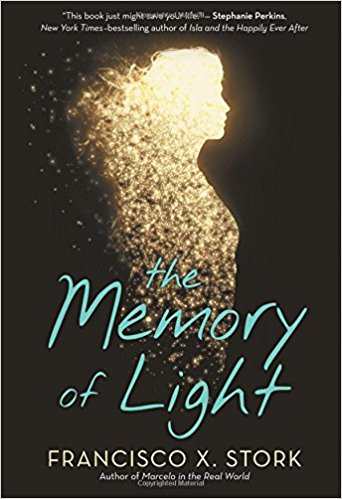
Six questions: Interview with Francisco X. Stork, author of The Memory of Light

I have to be honest here: This one I came across in the course of doing research for these interviews, and I was so interested in the plot I read it. It was gripping, heavy, painful and beautiful. It’s absolutely worth reading.

From the blurb:

“When Vicky Cruz wakes up in the Lakeview Hospital Mental Disorders ward, she knows one thing: After her suicide attempt, she shouldn’t be alive. But then she meets Mona, the live wire; Gabriel, the saint; E.M., always angry; and Dr. Desai, a quiet force. With stories and honesty, kindness and hard work, they push her to reconsider her life before Lakeview, and offer her an acceptance she’s never had.

But Vicky’s newfound peace is as fragile as the roses that grow around the hospital. And when a crisis forces the group to split up, sending Vicky back to the life that drove her to suicide, she must try to find her own courage and strength. She may not have them. She doesn’t know.

Inspired in part by the author’s own experience with depression, The Memory of Light is the rare young adult novel that focuses not on the events leading up to a suicide attempt, but the recovery from one — about living when life doesn’t seem worth it, and how we go on anyway.”

Here are six questions with Francisco X. Stork, author of The Memory of Light.

1) Your book is heavily inspired by your own experiences with depression. What made you decide to “go public,” so to speak, with that experience?

The decision to connect the story in The Memory of Light to my own experiences was made shortly before the book went into production. It was then that I wrote an author’s note where I mentioned my own life-long struggles with depression and with a suicide attempt when I was in graduate school. I had talked about my depression and bipolar disorder in my blog before, but it was the first time I talked about the suicide attempt. I realized that there was still a lot of shame and guilt associated with that and I thought that I should try to confront that shame and stigma, just like the characters in my book. I also wanted the readers of the book who were suffering from depression or considering suicide, to know that I understood in a very personal way what they were going through and that the hope and light offered by the book was hard-earned and genuine.

2) How much of you can be found in your main character?

One of the reasons I made my main character, Vicky, a young woman is that I thought it was important to create some separation from my own experiences and the main character. If the character had been male, I would have a tendency as I wrote to see myself as the main character. The distance between me and Vicky gave me the ability to filter my own experiences and feelings and transform them into those of a sixteen-year-old young woman and to express these feeling the way she would. Of course, there is a lot of me in Vicky. But the novel is not a memoir and so what mattered was the creation of a unique character that would be real in the heart of the reader.

3) Much of your book seems to deal with the resilience – the ability of the main character to cope. Did your book consciously attempt to teach readers how to build their own resilience? 

For many of us, even with medication, depression is a chronic condition and even when we are “well”, it is always there lurking beneath the surface. So “resilience” or the ability to cope and to live useful and peaceful lives despite of it, is an important goal. This requires that we let go of images of “happiness” that our society gives us and that we create our own realistic version of a life that contains joy and meaning despite depression.

4) How was The Memory of Light therapeutic for you? Or was it? Did you find it dredging up old memories?

I’m not sure “therapeutic” is the right word. The book did not cure my depression or necessarily make me feel better for expressing heretofore hidden truths about myself.  When you seek to write fiction as opposed to memoir, the goal is to create an experience for the reader, something that touches him or her in a real way. The benefits for the writer, when fiction is done well, is the unforeseen discoveries about self and the world that the writing brings about. I understood and saw things about the illness of depression and how to live with it, that I had not understood and seen before. I felt less anger toward my own depression and was able to see the negative moods that come with depression with less condemnation and judgment and with a greater awareness that these negative states were not permanent.

5) What do you think readers can learn from your book about depression and recovery?

My hope is that in the process of reading the book, the reader will become involved with Vicky and the other characters in the book and grow to care for them. If that happens, there will be a good chance that the reader will be able transfer that same care and love to him or herself. The horrible thing about depression is the feeling that we are not good enough, that we are not worthy of all the good that life offers. But when you see a character like Vicky slowly learn to accept the good in her and in others, then it will be easier for us to feel the same about ourselves and about others.

6) The book is now about two years old. Anything you wish you had or had not done with it?

The Memory of Light took me a long time to write and I went through various drafts making sure that the final product would be one that offered hope to a person who was considering whether life was worth living. I’m happy with the book as it is. During the past two years I’ve heard from young people who were touched by the book and found light and hope because of it. That is what I hoped the book would do. The book is no longer mine. It belongs to the reader.

If you enjoy books about young adults and mental health, then I encourage you to check out my upcoming novel, Redemptionwhich will be out on June 5 but is available for pre-order at a discounted price today. Redemption is a young adult/sci-fi thriller about depression, anxiety and saving the world.

Depression and meditation

Ugh, just writing this article makes me a little depressed. Why? Well, cause I can’t stick with this. No matter how hard I try, I absolutely, positively cannot stick with meditation – and that’s despite the evidence I’m about to write about below.

The studies are clear and I have written about the subject before: Meditation helps with depression. According to one study published in The Lancet, meditation may be as useful as anti-depressants at keeping depression at bay (side note: Damnit! I really need to look at this again!). This study noted the benefit of mindfulness meditation, which is a specific type of meditation.

What is mindfulness meditation? Mindful.org describes it simply: “Take a good seat, pay attention to the breath, and when your attention wanders, return. By following these simple steps, you can get to know yourself up close and personal.”

Want to know more? I found a few interesting resources on the subject. First, there’s this, from Headpsace, a meditation app I’ve used before. The article details the struggles of a very depressed man who tries meditation in a desperate attempt to get some relief and how meditation changes the way he thinks. The Washington Post ran a similar story earlier in the year, in which the author discusses how the Headspace app (this isn’t a sponsored post, I swear) helped them relearn their thinking.

Want more info on the research behind meditation? Check out this article on Mindfulness-Based Cognitive Therapy, which is a specific type of meditation designed to help those with depression.

If you’re interested in more information on how meditation may help people with anxiety and depression, look at this pretty fascinating article from Harvard, which details specifically how depression can physically change your brain.

I will say this: As I’ve bitterly noted repeatedly, there have been many instances where I have actually meditated with some regularity, only to stop after some period of time. But, during those times, I did notice some changes about the way I was thinking. Specifically, I found myself focusing less often on anger, frustration and bitterness. I found myself better able to let things go, and it felt great. Sadly, inevitably, a busy life caught up with me, and I let the practice fall away.

Time to try again!

As always, I conclude with a question: What has been your experience with meditation? Have you practiced it – or do you practice it – on a regular basis? Notice any changes that you want to share with us? Please tell us your story in the comments below!