Blog

Corona is frightening – here’s how to avoid freaking out

Yeah, I can’t lie, I’ve been stressed about Corona too. As I type this on Saturday morning, 103,739 people have the disease and 3,522 have died. By the time you read this, sadly, both of those numbers will have increased.

Corona is obviously having major ramifications on the world economy, and economists have noted that the potential for this disease to harm our wallets is extremely high. The federal government isn’t exactly doing a bang-up job of instilling confidence in their ability to fight back against this disease, with the President and his staff regularly boasting that the disease is contained when we know that just isn’t true.

An objective look at the facts makes it very likely that the disease is only going to get worse. And, if you have a mental illness, this is likely enough to cause no shortage of panic or anxiety. I had a regularly scheduled appointment with my therapist the other day and asked him if Corona was coming up more often in sessions; he said yes, absolutely.

I certainly can’t blame anyone for being stressed about a potential worldwide pandemic. It is frightening, and even more so if you have a health condition that may make you more prone to becoming ill. That being said, I think that it is important that we keep the coronavirus in perspective and avoid treating it like a death sentence. There are some things we can do to maintain our mental health during this outbreak. Here’s a look.

Focus on what you CAN do

Anxiety – at least to me – is largely about control. I always feel most anxious in situations where I am somehow powerless or helpless, and I know that this is a relatively common theme. Corona is so frightening precisely because it seems as if you have so little control.

Look, that’s not exactly true. There are some things – many things – you can do right now. As noted by governmental officials, you should be:

  • Practice good hygiene. Wash your hands for 2 minutes and multiple times a day, avoid touching your face.
  • Don’t travel to areas with noted outbreaks.
  • Stock up on your emergency kits in the event that there is a disruption of day to day activities.
  • Make plans for you and your family or work in the event that someone gets sick.
  • Research the Coronavirus for symptoms. They appear to be flu-like symptoms.
  • Only get your news from reputable sources. Read something on Twitter? Don’t believe it unless you can confirm it.

And once you do that: Stop. You’re okay. If you are doing everything you can to prevent Corona…well, good! You got this.

Recognize that anxiety has a use

This Lifehacker article on the subject absolutely nails it: Anxiety serves an evolutionary purpose. Yes, anxiety disorders are clearly not helpful, but remember, the purpose of anxiety is to keep you on your toes for any perceived threat. A bit of anxiety over a global pandemic is not a bad thing! It helps ensure that you are keeping informed of developments about the virus and that you don’t take this disorder too lightly.

When you’re feeling anxious, don’t try to suppress it. Try to logic your way through it. Ask yourself:

  • What is the threat? Is there any immediate threat?
  • Are you doing what you can to prevent and prepare for Corona?
  • What do the authorities recommend that you do right now?
  • Do you have an emergency plan?

If you’ve answered these questions satisfactorily, then you’re probably more prepared than the vast majority of society to deal with Corona. Congrats!

Limit your news intake

Throw CNN and Foxnews out the window.

Okay, don’t do that. But remember, the purpose of many news stations isn’t just to keep you informed. It’s to panic you so you need to constantly be turning the news on. These guys profit off of your fear, and yes, they have their use, but don’t sit there, staring at CNN, waiting for the next BREAKING NEWS ALERT (“Wolf Blitzer is coughing, what does this mean!?!?!”). Watch the news at regular intervals, certainly. Stay informed. But at some point, turn the damn TV off.

Of course, there are more tips, and I’d love to hear whatever your recommendations are for staying calm during a viral outbreak. Any tips you want to share with us? Leave them in the comments below!

 

Landmines and Ballerinas: How to cope with a lack of sleep when you’ve got mental health issues

For a lot of reasons, I slept like hell last night. For me, that’s dangerous. To be clear, all of us need a good amount of sleep in order to function the next day – I need at least five hours, I’d say, to be able to fire on all cylinders.

However, and this goes without saying, there is a huge connection between mental health and sleep. A lack of sleep can hurt your mental health, and mental health challenges can hurt your ability to get sleep. I know that both of these items are true for me, and I also know that on nights where I barely sleep (like three hours or less), I can barely function. As I said to my wife today, it feels like my head is filled with landmines and ballerinas that are blowing up those landmines. I absolutely cannot think straight. Of course, that may make this blog entry kind of interesting, so if I write out CHEEEEEEESE or something with no context, just bear with me.

Anyway. If you are like me, this can be a real challenge. A lack of sleep fires every one of my depression and anxiety genes, and I feel like I lack the coping and logic skills to get those emotions back in the bottle. My head feels like it’s filled with fog and sand.

How do I deal with this? I’m not quite sure yet, to be honest. But, broadly speaking, here are some thoughts.

Treat it as a sick day

Look, when you don’t sleep, you feel like crap, right? Take it for what it is: It’s a sick day. I’m not saying curl up in bed and take the day off from work – that may not be an option – but what I am saying is you should go easy on yourself. It’s not as if you somehow asked for mental health problems or to sleep like crap. Give yourself a break, and don’t hold yourself to the same standards that you may do on an otherwise normal day.

Ask yourself what you can do

One of the more impactful moments of my life came about a year after my son was born and when my wife was pregnant with our daughter. I was much, much heavier – 31 pounds or so, depending on the day. And I was upset. I’d really let myself go. And I was complaining about it to my wife, but the complaints weren’t action-oriented. They were just me bitching. And she said the line to me:

“So, what are you going to do about it?”

I don’t know about you, but on days where I’m struggling for one reason or another, I always feel better when I ask myself that question. Look, everyone has bad days. But if they become a pattern,  you have to ask yourself that question. What are you going to do about it? And that’s a key question, because yeah, things may suck at the moment, but if you can say to yourself, “Yes, I can barely think straight and am probably less coordinated now than I am when I’ve had a few drinks, but what can I do to make sure I take care of myself?”

Nap…but…

According to sleep.org, a nap the next day can potentially be helpful, as it can help ease the impact of having trouble sleeping. However, timing is key: Early to mid-afternoon is best, as this decreases the chances of your naping hurting your ability to sleep later that night.

Ultimately, these are just some broad thoughts, and I’d be really curious to hear yours…particularly considering I’m about to go face first into my keyboard. Any advice would be appreciated!


The Difference Between Being Sad & Depressed

As someone who has a lifelong period of depression, I think the above question is one that I ponder on a somewhat regular basis – certainly more often than I wish I did. It’s sad, but it’s necessary, and it’s something I have to consider.

If you’ve stumbled across this blog entry, you may be asking yourself the same question. What, exactly, is the difference between being sad and actually being depressed?

First, the standard disclaimer: I’m not a doctor, therapist or anyone with any real training. Just a guy with a lifetime of experience at dealing with these issues and their related public policy implications.

That being said, this is an important question. It can determine a lot of next steps: Do I need to see a therapist? How seriously should I be taking my mood? Do I need to adjust my medication?

Some broad thoughts:

Length of time

Of all the factors below, I think I’d argue that this is the key difference. Depression – when it’s clinical – is something that lasts for more than just a few minutes or days. It lasts for weeks and it is relatively relenting. Indeed, some of the things listed below really aren’t the biggest problem if they are brief or intermittent. But, if the symptoms last for two weeks or more, you start to cross the threshold into something being clinically wrong.

The reason behind your mood

The reason behind your mood is a key issue. If there’s a clearcut reason (stress at work, sick family member, that sort of thing), of course, you are going to be down. Indeed, the DSM-V diagnosis for depression has a specific exception for bereavement. However, if the depression or mood feels disproportionate to the situation, or you can’t quite pinpoint what’s making you so sad, there may be something deeper going on.

Functionality

Everyone gets sad. But how the sadness affects your ability to function, and over an extended period of time, is the real key here. If you are sad, can you function? Can you still go to work? Are you too impaired or altered to be able to do your regular responsibilities?

Physical symptoms

Generally speaking, sadness doesn’t come with physical symptoms. Depression, however, often does. You lose appetite. You get an upset stomach or a major headache. You get sick. If this is something that’s happening to you, and you feel the sickness with a degree of intensity, well, there may be something more serious going on.

As you can probably see from the nuance I use above…there’s no easy answer here. I wish there was. But that’s the bitch about mood disorders. There’s no blood test. There’s no magic diagnosis. Yes, there are screenings, and therapists who can help you find your way (thank God), but there is often more nuance in this question than is preferable.

As always, I welcome and appreciate your comments. Anything to add? Where’d I go wrong? Let us know in the comments below.


I don’t care. Neither should you.

Ahh, what is that picture, you ask?

Well, that’s me, being an idiot.

The background: This past weekend, my kids, wife and I went to a Lehigh Valley Phantom game – that’s our local Minor League Hockey Team. We were joined by my buddy Pete, also a State Representative.

Like most sports teams, the Phantoms will entertain the crowds during breaks in the action with goofy contests on the big screen that is above center ice. This particular one was the “Awkward Dad Cam,” in which Awkward Dads were encouraged to strut their stuff.

Well. That’s my freakin cue.

Thus began the Macarena. Me, standing like an idiot, in a sea of sitting people, dancing the Macarena that had been entombed in my head thanks to one too many Bar Mitzvahs from 1995-1997. I was looking around for a camera and was about to give up when the above happened.

So, I’m the idiot in the leather jacket. My daughter is recoiling with laughter (at least I HOPE that’s why she is recoiling). My son is dancing, albeit wrong. My wife is cracking up. Only Pete’s daughter actually is in time with me!

So, yes, that was hilarious. I immediately get a couple of texts and messages (the only appropriate response to which was, “HEEEEEEEEEEEEY MACARENA!”), and one of those texts involved these pictures.

I ran with this, of course, posting it to my Facebook page. One of my friends commented that this was a very on-brand picture for me, which is funny because I had said the exact same thing in a text about it earlier.

A funny thing has happened in the past couple of weeks. I had a tough vote in Harrisburg, one that I had a lot of heartburn over. It put my head in a different place. I’ve never been one to care too much about what others think of me, but there’s an extent that I have to – I’m a politician – my success is literally based around what other people think of me.

But I’ve come increasingly to an important conclusion:

WEEEEEEEEEEEEEEEEEEEEEE

Life…life is too short to give a damn. That macarena was hilarious. It made everyone around me laugh, I got a bunch of texts, and it made me feel good. It made my kids feel good. I don’t need anything else. I went to bed smiling because of that.

It’s also probably not the thing I should have done as an elected official.

Life is too short. And let me ask you this: Don’t you look at those people who are who they are, no apologies and no regrets, and wish that was you? That’s who I want to be. I’ve never been particularly inhibited, but even less so now. Something snapped inside me. I like it. I want people to know me for who I am. That’s what I’ve done throughout my career, and that’s what I want to keep doing…maybe with even more honesty.

I don’t care what others think of me. Not really. And I’m going to try to keep that up. And I’ve found that there’s a real lightening of burdens if you feel that way. There’s one less item to keep track of, one less inhibition that keeps you from acting the way you want. I feel lighter. Feeling this way is well worth the risk.

Now, if you’ll excuse me…

The Availability Heuristic and You

Alright, you’ve read this blog before, right? So, what do I hate more than almost anything else, despite the fact that I just can’t stop checking it? Yes, social media. I’ve written over and over and over about how evil it is and how much harm it can cause and blah, blah, blah…

(Okay, yes, I know it isn’t necessarily THAT bad, and that it does have many positive benefits, but people should use it with caution)

Anyway, I had an interesting conversation the other day about how terrible things are in the world and how all it seems like you hear is bad news. My friend and I were discussing this, and he specifically mentioned the Availability Heuristic.

For those of you who didn’t take Psych 101, in the most simple terms possible, the Availability Heuristic is the notion that what you see is what you get. Your mind, when thinking of things, thinks of the loudest or most recent things that it sees.

And this, in turn, can really lead to depression. Particularly in a social media-heavy world.

Think about it: You sign onto social media, and what do you see? TRUMP SETS THINGS ON FIRE! DEMOCRATS SET BABIES ON FIRE!

I mean, I’m kidding…a little. But as you scroll, you get more and more depressed. We’re exposed to a good chunk of statistics and information that other generations couldn’t even fathom. This can warp our perception of the world and alter our moods and feelings.

Given the reality of the Availability Heuristic, I am convinced that this is part of why we have so much trouble in the universe today. We see and think of things that are only immediately available and memorable. And that’s the bad news.

I mention this because I think this is an interesting way of framing the conversation of social media. There’s a set, cognitive bias for why we think and feel the way we do, and the better we understand this, the more sense all of our minds will make. Remember, it’s not just you. Cognitive biases like these exist to poke us in the head and make us see things a certain way. They have their evolutionary benefits to be sure, but sometimes, they can run amok.

So, short of throwing your phone out the window, what can you do if you do find yourself getting depressed by the evening news and your Twitter feed? Remind yourself of this fundamental truth: The bad news is sticking in your brain more than the good. This is normal – even healthy to an extent – but it isn’t as bad as it seems.

New Suicide Statistics Show that Things Are Still Getting Worse, but…

The CDC has released new suicide statistics for 2018 (previous numbers were for 2017). The results, by and large, were problematic. In a nutshell:

  • Suicide deaths in America went from roughly 47,173 to 48,344. That’s an increase of about 1.4%.
  • Believe it or not, there’s good news here. The slope of the increase is starting to flatten: Suicides increased 4% from 2016-2017. This would imply…hopefully…that the rate of suicides is starting to slow down.
  • Suicide remains the 10th leading cause of death in the United States.

More data will likely be available in the future, including a breakdown of suicide methods and age breakdowns of those who died. That information, of course, will be particularly insightful. On a personal level, I’m deeply interested in the numbers in Pennsylvania. Since 2013, we’ve had suicide rates that are above the national average. I suspect that those trends remain unchanged and that we will see a small increase over the 2,030 people who took their lives in 2017.

There are two ways to look at these numbers, and I think that both are valid perspectives. On one hand, the problem continues to get worse. Suicide numbers are accelerating, and the numbers continue to get worse, as they have roughly ever year since around 2004.

On the other hand, as the American Foundation for Suicide Prevention accurately noted, there are reasons to be hopeful:

  • The rate of increase has slowed.
  • Awareness about the problems of mental illness and suicide continues to grow.
  • More and more people are going public with their own struggles.
  • More and more units of government are comprehensively addressing suicide and suicide prevention. Such a strategy appears to be working for opioid overdoses, and that should give us all hope when it comes to suicide prevention.

Indeed, articles like the one run by the Huffington Post on the subject do a great job of discussing suicide. They present the statistics in a rational, reasonable manner. They also present stories of hope and specific, concrete suggestions for how to deal with mental illness and suicide. Those suggestions – reach out, be non-judgemental, understand that suicide is a comprehensive illness – they are all evidence-based.

So, yes. There are reasons to be hopeful, but we must continue to acknowledge that we have a major mental health crisis in front of us. One which will require – demand – public policy decisions.


LGBT Marriage Equality Saved Lives

I’ve written extensively on the connection which society forces upon people who are LGBT and have a mental illness. To be clear, there is nothing inherently mentally ill about anyone who is LGBT: It is the societal pressures and discrimination faced by people who are gay or transgender which can give them a mental illness. This is a tragedy and a sin that we must address at a societal level.

If you’ve read this blog long enough, you know that one of the items I regularly harp on is the connection between mental illness and public policy. That connection was first driven home for me in a 2015 study which showed that members of the LGBTQ population had higher rates of mental illness and addiction in states where marriage equality wasn’t the law of the land than in states where it was legal. To be clear, this may be a classic case of correlation not equalling causation, as there may have been other reasons which LGBTQ people had better mental health in these states. However, it would certainly imply that there is a connection between mental illness and discrimination – a finding which was picked up in other countries, like Australia and New Zealand.

Finding that study was a critical moment for me, at least in terms of how I viewed mental health and public policy. Not only does public policy influence mental health, but it influences it in ways which we may not expect.

Well, here’s more proof: As noted in this Upworthy story, suicide attempts by LGBT youth dropped in states that legalized gay marriage and didn’t drop in states that didn’t. Similar findings were replicated in other countries that embraced marriage equality.

Again, the findings aren’t necessarily causational, but they would seem to pretty strongly imply a connection between societal stigma. Countless other studies have proven that treating any typically discriminated group with love, acceptance, and support can reduce their suicide rates. The legalization of gay marriage can make a massive difference here, as it ended a societally-enforced piece of discrimination.

Public policy and mental health matter, and matter deeply. We can, and should, examine all aspects of public policy through a mental health prism, as this connection exists in dozens of public policy spheres – everything from transportation to minimum wage to licensure laws and more.

New study: 13 Reasons Why did not cause an increase in suicides, and may have done some good

I’ve written repeatedly about Netflix’s 13 Reasons Why, and usually in a pretty damning light. Like others (who are far more informed and educated than I am), I’ve expressed my real concern that the show has unintentionally glamorized suicide, and there has been evidence to suggest that it actually led to an increase in suicides.

However, a new study shows that this may not be the case, and, in fact, that 13 Reasons Why may have done some good.

First, a review. 13 Reasons Why tells the story of Hannah Baker, a teenage girl who dies by suicide and leaves behind tapes for people to listen to, explaining why she died and their role in her demise. The show was criticized by many for glamorizing suicide and presenting it as a possible choice, and Netflix eventually removed the three-minute, highly graphic scene in which Hannah dies.

Of course, that removal came after being viewed millions of times, and at least one report directly tied the show to a rise in suicides.

However, a new study came to the opposite conclusion:

But a recent reanalysis of the data by Dan Romer, research director of the Annenberg Public Policy Center at the University of Pennsylvania, found no evidence of an increase in suicides for boys, and (like the original study) an insignificant increase for girls. Romer adjusted the data to factor in trends like an overall increase in adolescent suicides since 2007.

That’s important. But it’s not as important as this finding:

But when Romer conducted a study on 13 Reasons Why’s effects on self-harm, published last April, he found that teens who watched the entire second season of the show were less likely to purposely injure themselves or seriously consider suicide, even when compared with those who did not watch the show. He said that this could be because of the Papageno effect, which occurs when stories that portray people overcoming their suicidal crisis end up reducing suicide rates. The effect is named for a character in Mozart’s opera The Magic Flute who considered suicide until his friends showed him a different way to solve his problems.

The second season of 13 Reasons Why features a character who is depressed and considers suicide – but survives. This is important, and it feeds in with a larger theme in the mental health universe: We have to share stories of hope, of survival, and of seeking help successfully.

Part of the reason that so many (myself included) thought 13 Reasons Why was so damning, as portrayed, is because it features a character dying by suicide in a graphic manner. This can create copycat scenarios. However, the good news is that the Papageno Effect is real and has been repeatedly backed up by science. This is great news: If you can show someone finding hope, you can inspire others to do the same.

I appreciated this alternative perspective of 13 Reasons Why, and I appreciated the hope that it could potentially inspire in others. It also reinvigorates what I have said for ages: Share your story. It’s why I’m so passionate about sharing mine.

You can save a life.

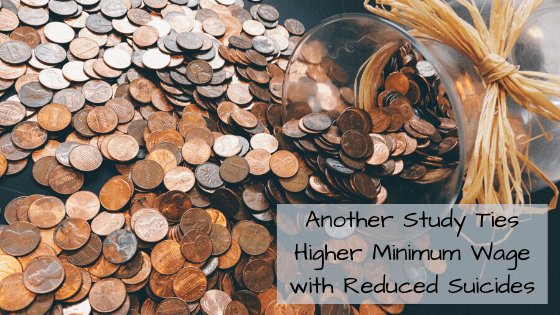
Another Study Ties Higher Minimum Wage with Reduced Suicides

I’ve written about it before: Economics and suicide are tied. To be clear, that’s not to say that poor people are more likely to die by suicide; by and large, suicide crosses economic boundaries. What is more likely to be associated with increases or decreases in suicide rates is a change in economic status: An increase leads to lowered suicide rates, while a decrease leads to higher rates.

And that brings us to this study, published in the Journal of Epidemiology & Community Health. The study examined 25 years of economic and suicide rates in all fifty states and Washington, D.C. From the results of the study:

The effect of a US$1 increase in the minimum wage ranged from a 3.4% decrease (95% CI 0.4 to 6.4) to a 5.9% decrease (95% CI 1.4 to 10.2) in the suicide rate among adults aged 18–64 years with a high school education or less. We detected significant effect modification by unemployment rate, with the largest effects of minimum wage on reducing suicides observed at higher unemployment levels.

In other words, an increase in the minimum wage can save lives.

This study was picked up in numerous major media outlets, including CNN and NPR. As the CNN story noted, if you assume that the data from this story is accurate, an increase of $2 could have saved upwards of 40,000 lives between 2009-2015.

This study shows many things, but there are two, in particular, I want to focus on.

First: It challenges the idea that suicide is exclusively related to mental health, or at least adds a qualifier and a modifier to that idea. I think that when most people think of suicide, they think that a person who dies by suicide must be mentally ill. That makes sense, of course, and it’s a perfectly logical conclusion to reach. However, it’s not completely supported by the evidence. If depression was the only thing that mattered when it came to a suicide attempt, the minimum wage wouldn’t make a difference unless you assume that economic status is tied directly to mental health.

What this shows, again, is that suicide is not simply a matter of mental illness.

And that leads me to my second point: Everything is connected. Mental health is deeply connected to economics, and if we can ensure a robust social safety net, fair wages and equal opportunity, we can reduce suicides and save lives. This study proves it – again – and it isn’t even the first to make the argument that work and work hours are tied to minimum wage.

As public policymakers, we have a job to address major problems (like the massive spike in suicides) in a manner that is holistic and comprehensive. That means not only improving access to mental health care but reducing the causes of suicide.

That means increasing the minimum wage.

Anxiety and a Rigid Life

I have a sincere question for you, and if you have anxiety issues, I suspect you know why I ask this.

One of the best ways I think I’ve ever summarized anxiety – at least the really bad, crippling kind – was by describing it as a box. You live inside the box. And slowly, as the anxiety ramps up, it gets worse, and the box starts to compress. Little by little, it squeezes you in, trapping you and stopping you from doing things you previously enjoyed. Going out late at night. Living with spontaneity. And then you just find your life stuck inside this box, regimented by routines and a fear of fear that you don’t fully understand but absolutely cannot conquer.

Here’s my question: Is this you? Because it does feel like me.

As I’ve discussed previously, generally speaking, I feel like I live a life in recovery. That’s a bit of a complicated statement because I unquestionably still suffer from a series of anxiety and depression related issues. But I say it because I feel like I can lead a good life and a relatively happy one.

But, there’s no question about it: I lead a life that has been limited by anxiety.

Examples? I can’t stand surprises. I have to know where I’m going and what I’m doing. Open social situations – parties, etc – can be intimidating. Weird thing for a politician to write out, right?

I crave routine. I like to be doing X at this time and doing Y at this time. I’m obsessed with my calendar and my to-do list because they keep me on schedule and knowing what I am doing, something I crave and need.

Do I think I’m living in a box still? No. I don’t. But I do think there are some ceilings in my life. Some things which are limited by my anxiety.

Huh. This has been instructive to write. Might be something I want to bring up in therapy later because it’s not something I want to live with. I’d love to live with a bit more flexibility and spontaneity. I’d love to be able to go out places without…fear.

It’s a defense mechanism for me. A coping skill, one developed by the unfortunate reward your body gives out for avoiding the anxiety caused by anxiety-inducing situations. Repeat this pattern enough times and you have agoraphobia. No, that certainly isn’t me, but it is something I always feel like I have to watch out for because I am a natural homebody. I think this is a big part of why.

All of that being said, if you know what I’m talking about, if this writing strikes a chord with you, please comment below and let me know what you think. Does this sound familiar? How do you deal?