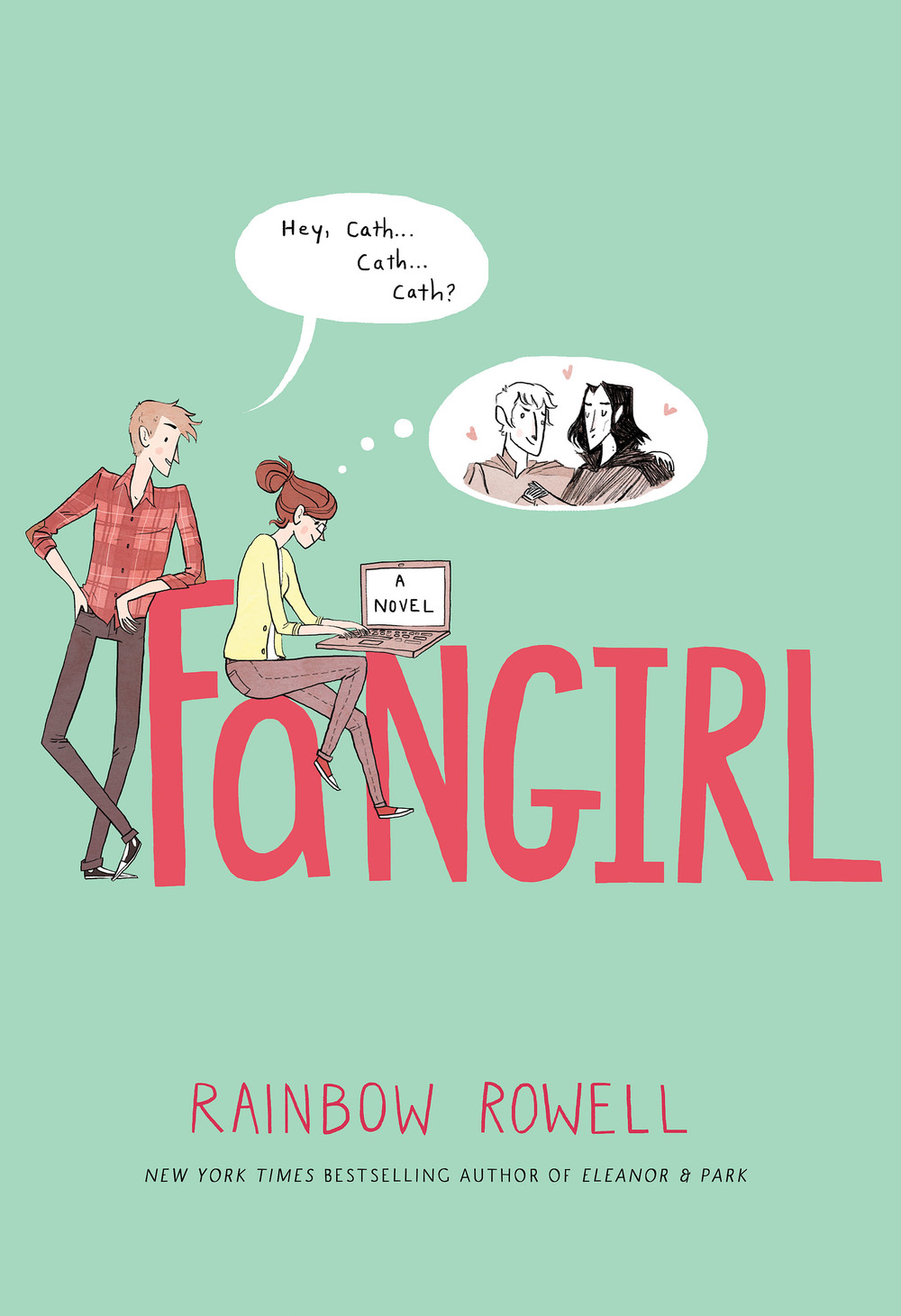
As I’ve said before, one of the things that has helped me cope with my anxiety/depression issues. There’s a few reasons for this, and I’ll get into that shortly, but I wanted to write what basically amounts to a thank you note to Rainbow Rowell, author of Fangirl, and talk a little bit about how I found a wonderful creative outlet…and, maybe, how you can too.
First, my personal history. Ever since 8th grade, I’ve loved to write. Like most young, male teenage authors, the first thing I ever wrote was…uhh, Star Wars fan fiction. It was terrible, but that’s completely besides the point. At the time, it made me extremely happy, and why not? It gave me the opportunity to create, and feel like I was part of a franchise that I adored. During my teenage years, writing continued – I wrote two full-length novels (unpublished, of course, probably because they were pretty bad). In college, as the anxiety and stress continued, I tried my hand at poetry. Again, it gave me…something. The chance to express what I was feeling, and in putting it on paper, leave a piece of it behind.
What I remember the most about these novels, even more than their plot, is that they helped me cope. Novel number one was about my family history, the loneliness that came with it and just being a teenager in general. Number two was working through some of the challenges I had in my family at the time.
Both novels gave me hope. They gave me a sense of control. And in my worst, most loneliest moments, they gave me something to hold onto. Not for nothing, but novel #2 never made it through revisions. Once I came to peace with what was happening in my life, I more or less stopped writing it.
This was all in high school. Fast forward fifteen years: I’m married, two wonderful kids and a State Representative. To my surprise, I managed to achieve a dream and become a published author, but a non-fiction book: Tweets and Consequences.
It was around the first half of 2015 that I hit a rough patch with my depression, arguably one of the rougher ones I had hit in years, maybe even since college, when my depression and anxiety really first began/exploded onto the scene. At the time, I remember feeling misreable and just so helpless, searching desperately for a way out that I just couldn’t find.
What wound up pushing me to a better place was writing. And what helped get me there was Fangirl by Rainbow Rowell. From the book:
In Rainbow Rowell’s Fangirl, Cath is a Simon Snow fan. Okay, the whole world is a Simon Snow fan, but for Cath, being a fan is her life-and she’s really good at it. She and her twin sister, Wren, ensconced themselves in the Simon Snow series when they were just kids; it’s what got them through their mother leaving.
Reading. Rereading. Hanging out in Simon Snow forums, writing Simon Snow fan fiction, dressing up like the characters for every movie premiere.
Cath’s sister has mostly grown away from fandom, but Cath can’t let go. She doesn’t want to.
Now that they’re going to college, Wren has told Cath she doesn’t want to be roommates. Cath is on her own, completely outside of her comfort zone. She’s got a surly roommate with a charming, always-around boyfriend, a fiction-writing professor who thinks fan fiction is the end of the civilized world, a handsome classmate who only wants to talk about words . . . And she can’t stop worrying about her dad, who’s loving and fragile and has never really been alone.
For Cath, the question is: Can she do this? Can she make it without Wren holding her hand? Is she ready to start living her own life? And does she even want to move on if it means leaving Simon Snow behind?
The book resonated with me because the main character, Cath, is clearly having major adjustment issues to college (as I had) and discovering who she is. She uses her writing to cope and get her to a better place, and the book details her struggle in terms of finding a voice that is authentic and truly belongs to her. Cath is clearly a talented writer, and the book explores her writing journey, meshing with her adjustment to college, family separation, romantic experiences, academic struggles and more. I’d also argue – and many others have also made this comment – that Cath is clearly suffering from some form of depression.
And that is exactly where the book hits a chord for me. I remember there being one scene where Cath is in an advanced writing class with older students, and the professor – a big time author, if memory serves – is asking the class why they write. One student answered “therapy.” And that’s a note that just rang so, so true to me.
For me, writing was always a therapy for a variety of reasons:
- It allowed an escape. An idealized world where every situation could be reasonably thought through, all alternatives explored, and all potential problems dealt with accordingly.
- It allowed me the chance to work through problems, to put myself in someone else’s shoes. In a sense, I think writing allows you to sort the various parts of your head and put them somewhere better.
- It allows you to mark the moment. And I don’t mean remember. I mean something stronger. To carve it into your consciousness and make sure that the emotional core of an event – everything you are trying to deal with – are always remembered. Every feeling, every sensation.
- You can play God. Play the hero, play the villain, whatever you want.
- Ideally, you can work through your past, and channel it into something good. I think that’s an important theme of my overall mental health journey: Once I realized I could go public, and help other people in the course of doing so, I became a better public official and a better person.
To those of you who write, in any form, for mental health purposes – I feel you. And to those of you who don’t – maybe give it a go.

 Mike Schlossberg - Author