The language of suicide, and why it matters

As you may have noticed, whenever I discuss suicide on this blog, I’m always very careful on how I phrase it, although researching this blog entry has made me realize that I’ve been messing this up to. There are words and phrases you should and should not use when describing suicide – here’s a quick overview about some best practices.

Why “committed suicide” is bad

This one is more obvious and stigma oriented. Simply put, “committed” is used to describe a crime. Someone committed a murder. They committed a robbery.

Committed, in this context, is usually associated with a moral judgement, and that’s not a way that any of us want to describe suicide. Suicide and mental illness shouldn’t be associated with a moral failing. Doing so can make people who suffer feel weak or ashamed, and that can serve to increase the stigma that surrounds both mental illness. The language we use should encourage others to seek help, not drive them into a closet of fear and shame.

Why “completed suicide” is also bad

This is the phrase I’d always used – I viewed it as preferable – but this is a really good point:

Think of the sense of accomplishment you feel when you complete a big project. Then think of the disappointment you feel when you don’t.

Completion is good, and suicide isn’t.

To complete something conveys success; to leave something incomplete conveys failure.

Indeed, we do associate completion with success, and no one’s suicide should be viewed as a success. So, there must be something else.

The alternatives

I think the AP is on track when it comes to these alternatives. The phrases used here are preferable, in that they are accurate and avoid the moral connotations that comes with “completed” and “committed.”

Language matters. Words matter. We know that the way we describe an action can unintentionally pass judgement over the action and can increase or decrease the stigma that comes with it. All of us have an obligation to be careful in the way we talk, and I’m going to be better at this from now on.

And one more thing: In our society, there’s been a backlash against being “politically correct” when it comes to how we describe things. My experience has been that this backlash is more orientated around being a decent and non-racist person, but that’s besides the point.

The way we discuss suicide has nothing to do with political correctness. It has everything to do with creating an environment that makes people feel safe, that supports (rather than harms) their mental health, and that can increase the odds of someone seeking help instead of ending their life.

Any thoughts you want to add? Any other language recommendations? I’d love to hear them – please let us know your thoughts in the comments!

Three ways social media can be good for your mental health…I guess….

Despite my own personal obsession with social media, I have written repeatedly about how bad it can be for your mental health. That being said, I remembered something the other day: Social media changed my life in a very important way. It was through someone else’s stupidity, but that still counts!

Allow me to refer to a blog entry last week:

Let me go backwards. Robin Williams completed suicide on August 11, 2014. He had long suffered from a slew of mental health challenges, including depression and substance abuse. However, Williams was suffering from “diffuse Lewy body dementia,”which ultimately contributed heavily to his suicide.

William’s suicide ultimately inspired me to go public with my story. That started when some idiot on Facebook decided to spout off shortly after Williams’ death by saying something along the lines of, “So sad Robin Williams committed suicide. He just needed to pray to Jesus more!”

No, you schmuck, that’s not how it works, and that ignorant comment got me so damn fired up that I wrote an op-ed in my local paper, detailing my own struggles with depression, anxiety and suicidal ideation. That, in turn, set my career in motion in a very different way, making me become much louder about mental health issues. I’ve spoken at events detailing my own struggles, cofounded a mental health caucus, appeared in PSAs and introduced legislation designed to help those who are suffering from mental health challenges. I know that the work I’ve done in this realm has helped people – and I know I have a lot more to do to help more.

As much as I hate to admit it, while thinking of this moment the other day, I realized something: It happened because I was on Facebook at that one specific moment. If I hadn’t been, I would never have had this very positive, life-changing experience. My life would be dramatically worse.

So, even I must admit: Social media can be good for your mental health.

How else can it be helpful? Here’s a few thoughts, but with an important caveat: It all depends on the users. Social media can be good for your mental health, but that only occurs if you are willing to approach it from a certain perspective and/or change your way of thinking.

1) Social support: I firmly believe that social media cannot replace real-world interactions – but that’s not to say that they don’t have a place. Social media can help people feel connected to each other if people join supportive groups, develop healthy relationships and give as much as they take over the course of regular conversations. It can also make it easier to discuss important problems:

A common dilemma among people with mental illness (including depression) is the reluctance to talk to people closest to them about their problems. More and more young people are turning to the Internet for health advice, including topics such as contraception, acne treatments, etc. Far from being a singularly-destructive force in their development, social media can, in fact, do quite the opposite.

This is the opposite of the unrealistic expectations that haunt so many on social media. Instead of making people feel more isolated, it makes them feel more connected – and less alone.

2) You can get closer and learn more about people you’re already friends with: My wife and I have a running joke that, whenever we go to a public event, someone will say something to me about my most recent Facebook post. I try to return the favor whenever possible. Social media – when used to strengthen real world relationships – can be very helpful.

3) You can actually learn something: We’ve all seen it – the political conversation that isn’t really so much a “conversation” as it is “two idiots yelling at each other and accomplishing nothing other than polluting your Facebook wall with their mind garbage.” Social media isn’t always the most conductive place to have a political conversation – but, imagine, for a moment, that you approach a political debate with a different perspective. A willingness to listen and to learn. It is possible to actually learn something from social media debates if you can change your mindset and approach these conversations with an open mind. Maybe you won’t be convinced of someone else’s viewpoint, but hopefully, at least, you can better understand their perspective, and that’s exceptionally important in today’s fragmented society.

As always, I welcome your thoughts. What am I missing here? Let us know in the comments!

Six questions: Interview with Francisco X. Stork, author of The Memory of Light

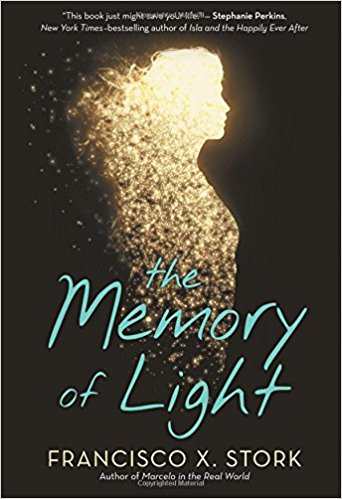
I have to be honest here: This one I came across in the course of doing research for these interviews, and I was so interested in the plot I read it. It was gripping, heavy, painful and beautiful. It’s absolutely worth reading.

From the blurb:

“When Vicky Cruz wakes up in the Lakeview Hospital Mental Disorders ward, she knows one thing: After her suicide attempt, she shouldn’t be alive. But then she meets Mona, the live wire; Gabriel, the saint; E.M., always angry; and Dr. Desai, a quiet force. With stories and honesty, kindness and hard work, they push her to reconsider her life before Lakeview, and offer her an acceptance she’s never had.

But Vicky’s newfound peace is as fragile as the roses that grow around the hospital. And when a crisis forces the group to split up, sending Vicky back to the life that drove her to suicide, she must try to find her own courage and strength. She may not have them. She doesn’t know.

Inspired in part by the author’s own experience with depression, The Memory of Light is the rare young adult novel that focuses not on the events leading up to a suicide attempt, but the recovery from one — about living when life doesn’t seem worth it, and how we go on anyway.”

Here are six questions with Francisco X. Stork, author of The Memory of Light.

1) Your book is heavily inspired by your own experiences with depression. What made you decide to “go public,” so to speak, with that experience?

The decision to connect the story in The Memory of Light to my own experiences was made shortly before the book went into production. It was then that I wrote an author’s note where I mentioned my own life-long struggles with depression and with a suicide attempt when I was in graduate school. I had talked about my depression and bipolar disorder in my blog before, but it was the first time I talked about the suicide attempt. I realized that there was still a lot of shame and guilt associated with that and I thought that I should try to confront that shame and stigma, just like the characters in my book. I also wanted the readers of the book who were suffering from depression or considering suicide, to know that I understood in a very personal way what they were going through and that the hope and light offered by the book was hard-earned and genuine.

2) How much of you can be found in your main character?

One of the reasons I made my main character, Vicky, a young woman is that I thought it was important to create some separation from my own experiences and the main character. If the character had been male, I would have a tendency as I wrote to see myself as the main character. The distance between me and Vicky gave me the ability to filter my own experiences and feelings and transform them into those of a sixteen-year-old young woman and to express these feeling the way she would. Of course, there is a lot of me in Vicky. But the novel is not a memoir and so what mattered was the creation of a unique character that would be real in the heart of the reader.

3) Much of your book seems to deal with the resilience – the ability of the main character to cope. Did your book consciously attempt to teach readers how to build their own resilience? 

For many of us, even with medication, depression is a chronic condition and even when we are “well”, it is always there lurking beneath the surface. So “resilience” or the ability to cope and to live useful and peaceful lives despite of it, is an important goal. This requires that we let go of images of “happiness” that our society gives us and that we create our own realistic version of a life that contains joy and meaning despite depression.

4) How was The Memory of Light therapeutic for you? Or was it? Did you find it dredging up old memories?

I’m not sure “therapeutic” is the right word. The book did not cure my depression or necessarily make me feel better for expressing heretofore hidden truths about myself.  When you seek to write fiction as opposed to memoir, the goal is to create an experience for the reader, something that touches him or her in a real way. The benefits for the writer, when fiction is done well, is the unforeseen discoveries about self and the world that the writing brings about. I understood and saw things about the illness of depression and how to live with it, that I had not understood and seen before. I felt less anger toward my own depression and was able to see the negative moods that come with depression with less condemnation and judgment and with a greater awareness that these negative states were not permanent.

5) What do you think readers can learn from your book about depression and recovery?

My hope is that in the process of reading the book, the reader will become involved with Vicky and the other characters in the book and grow to care for them. If that happens, there will be a good chance that the reader will be able transfer that same care and love to him or herself. The horrible thing about depression is the feeling that we are not good enough, that we are not worthy of all the good that life offers. But when you see a character like Vicky slowly learn to accept the good in her and in others, then it will be easier for us to feel the same about ourselves and about others.

6) The book is now about two years old. Anything you wish you had or had not done with it?

The Memory of Light took me a long time to write and I went through various drafts making sure that the final product would be one that offered hope to a person who was considering whether life was worth living. I’m happy with the book as it is. During the past two years I’ve heard from young people who were touched by the book and found light and hope because of it. That is what I hoped the book would do. The book is no longer mine. It belongs to the reader.

If you enjoy books about young adults and mental health, then I encourage you to check out my upcoming novel, Redemptionwhich will be out on June 5 but is available for pre-order at a discounted price today. Redemption is a young adult/sci-fi thriller about depression, anxiety and saving the world.

Depression and meditation

Ugh, just writing this article makes me a little depressed. Why? Well, cause I can’t stick with this. No matter how hard I try, I absolutely, positively cannot stick with meditation – and that’s despite the evidence I’m about to write about below.

The studies are clear and I have written about the subject before: Meditation helps with depression. According to one study published in The Lancet, meditation may be as useful as anti-depressants at keeping depression at bay (side note: Damnit! I really need to look at this again!). This study noted the benefit of mindfulness meditation, which is a specific type of meditation.

What is mindfulness meditation? Mindful.org describes it simply: “Take a good seat, pay attention to the breath, and when your attention wanders, return. By following these simple steps, you can get to know yourself up close and personal.”

Want to know more? I found a few interesting resources on the subject. First, there’s this, from Headpsace, a meditation app I’ve used before. The article details the struggles of a very depressed man who tries meditation in a desperate attempt to get some relief and how meditation changes the way he thinks. The Washington Post ran a similar story earlier in the year, in which the author discusses how the Headspace app (this isn’t a sponsored post, I swear) helped them relearn their thinking.

Want more info on the research behind meditation? Check out this article on Mindfulness-Based Cognitive Therapy, which is a specific type of meditation designed to help those with depression.

If you’re interested in more information on how meditation may help people with anxiety and depression, look at this pretty fascinating article from Harvard, which details specifically how depression can physically change your brain.

I will say this: As I’ve bitterly noted repeatedly, there have been many instances where I have actually meditated with some regularity, only to stop after some period of time. But, during those times, I did notice some changes about the way I was thinking. Specifically, I found myself focusing less often on anger, frustration and bitterness. I found myself better able to let things go, and it felt great. Sadly, inevitably, a busy life caught up with me, and I let the practice fall away.

Time to try again!

As always, I conclude with a question: What has been your experience with meditation? Have you practiced it – or do you practice it – on a regular basis? Notice any changes that you want to share with us? Please tell us your story in the comments below!

Six questions: Interview with Heidi Ayarbe, Author of Compulsion

Hello, everyone! Another day, another author interview. This one is with Heidi Ayarbe, who wrote Compulsion, a multi-layered story of OCD in a young adult. From the blurb:

Today has to be perfect.
Magic.
I look at the clock.
10:14 AM.

Ten fourteen. One plus one is two plus four is six plus ten is sixteen minus one is fifteen minus two is thirteen. OK.

I turn from the clock and walk into the hallway. “Ready.”

Saturday will be the third state soccer champion­ship in a row for Jake Martin. Three. A good number. Prime. With Jake on the field, Carson City High can’t lose because Jake has the magic: a self-created protection generated by his obsession with prime numbers. It’s the magic that has every top soccer university recruiting Jake, the magic that keeps his family safe, and the magic that suppresses his anxiety attacks. But the magic is Jake’s prison, because sustaining it means his compulsions take over nearly every aspect of his life.

Jake’s convinced the magic will be permanent after Saturday, the perfect day, when every prime has converged. Once the game is over, he won’t have to rely on his sister to concoct excuses for his odd rituals. His dad will stop treating him like he is some freak. Maybe he’ll even make a friend other than Luc.

But what if the magic doesn’t stay?

What if the numbers never leave?

Acclaimed author Heidi Ayarbe has created an honest and riveting portrait of a teen struggling with obsessive compulsive disorder in this breathtaking and courageous novel.

1) Is your book based on personal experiences, and how did your life experiences inform your description of OCD?
I do not have OCD, though I do deal with anxiety. A friend of mine has severe anxiety and OCD. I spent a lot of time with her, sharing scenes, asking how she’d react in certain situations. Naturally, every person with anxiety doesn’t react the same. Having her as a sounding board and sensitivity reader made all the difference in this novel. The climactic scene, in which Jake physically can’t go help his sister, mirrors a similar situation in her life in which she couldn’t help her daughter. That is how crippling it is. And so often I’ve seen OCD and anxiety represented as a punchline for someone’s character in a story or TV show when it’s anything but funny. And so so hard to understand.
 
2) Your book deals with the mental and physical aspects of OCD. How difficult was it to describe what these felt like?
I think anybody who has experienced a panic attack can appreciate how out-of-body and uncontrolled you feel during that moment. It’s terrifying. And, yes, I really think it’s hard to describe that moment when everything feels electric and fuzzy at the same time. And the pre-moment, when you know it’s going to happen. It’s like a tidal wave taking over your body, and you just have to brace yourself for it. During those scenes, I just tried to express how I felt during a panic attack. I haven’t had many, but they leave an imprint on you.
 
3) How did you balance the need to make this book broadly appealing to an audience at large and a desire to make it speak specifically to those who have been affected by OCD?
Honestly, I only thought about Jake’s story and being true to him. Certainly, as an author, our job is to connect with readers. That said, I think telling our truth, and finding the truth in our characters, is primordial, or it can come off as contrived. So, honestly, I was only thinking about Jake’s story. It really was important to me. And by being honest and vulnerable, I hope that it appealed to readers.
 
4) In the book, you describe a character driving to the moment when the “magic” will stay and everything will be alright in Jake’s life – were you intentionally trying to use this concept to make the book more relatable to all readers? That’s how I read this aspect, but I could be wrong.
Anxiety disorders (specific phobias, social anxiety disorder, agoraphobia, and OCD among others) don’t make sense in a “rational world.” So I tried to create a reasoning that Jake could hold onto to make sense of the disorder himself. If we think about anxiety disorders, and approaching them from an outside-looking-in, Jake, too, was trying to make sense of his own disorder. He used sports and “magic” to do so. So I used this idea more for Jake. How would he justify what was happening to him? Again, it’s his story.
 
5) Why prime numbers?
When I was researching OCD, so many different forms exist. Though the jury is out on whether anxiety disorders are hereditary or social, or, most likely, a combination of both, no two people deal with anxiety the same way. So they can be unrecognizable to each other. Like Jake’s mom suffers from scrupulosity. He definitely doesn’t see himself mirrored in her, at all. They don’t connect, though they both suffer. Most characters I’ve seen portrayed with OCD focus on germs, cleanliness, having everything perfectly organized etc. I guess it’s easier to address something like that visually. As novelists, though, we get to use the mind!  I was thinking about athletes and an athlete mentality. A friend of mine’s son used to count words. All of his sentences had to have an odd number of words. So I started to consider numbers, prime, and how Jake could relate them to sports. This seemed more natural to me. And I know some readers found it frustrating, even difficult, dealing with the constant adding, subtracting, searching through numbers in Jake’s mind. Imagine living that, though.
 
6) Can you talk a little about the impact this book had on readers? Did you hear from anyone who said that your writing helped them get help or recognize OCD in themselves/others?
This is one of those questions I’d love to say, “I simply don’t have time to address the endless e-mails that flood my inbox.” I get more of a desert drizzle of mails from readers (which means not many). That said, Compulsion was on Taysha’s list and received a lot of good reviews, even starred. Perhaps, by focusing so much on Jake I didn’t connect to readers as I’d hoped? I’m not sure. It’s a weird job. I love Jake. I love his story. And I tried my hardest to be honest. I think, as authors, that’s what we owe our readers (all five of them!) teehee!!
If you enjoy books about young adults and mental health, then I encourage you to check out my upcoming novel, Redemptionwhich will be out on June 5 but is available for pre-order at a discounted price today. Redemption is a young adult/sci-fi thriller about depression, anxiety and saving the world.

Finding light in the darkness

I’m going to write about two things that personally motivated me to deal with my own demons in a very public way. The short-term inspiration for this is me rereading the acknowledgements section of Redemption. The longer-term inspiration for this is a public tragedy and a low period in my life.

Okay, first, here’s a small section of the acknowledgements in Redemption:

To Robin Williams. Yours was a life well lived, and I hope to be part of a positive story of those influenced by how it ended.

Let me go backwards. Robin Williams completed suicide on August 11, 2014. He had long suffered from a slew of mental health challenges, including depression and substance abuse. However, Williams was suffering from “diffuse Lewy body dementia,” which ultimately contributed heavily to his suicide.

William’s suicide ultimately inspired me to go public with my story. That started when some idiot on Facebook decided to spout off shortly after Williams’ death by saying something along the lines of, “So sad Robin Williams committed suicide. He just needed to pray to Jesus more!”

No, you schmuck, that’s not how it works, and that ignorant comment got me so damn fired up that I wrote an op-ed in my local paper, detailing my own struggles with depression, anxiety and suicidal ideation. That, in turn, set my career in motion in a very different way, making me become much louder about mental health issues. I’ve spoken at events detailing my own struggles, cofounded a mental health caucus, appeared in PSAs and introduced legislation designed to help those who are suffering from mental health challenges. I know that the work I’ve done in this realm has helped people – and I know I have a lot more to do to help more.

It also inspired this speech, the most difficult one I have ever made:

Fast forward about seven or eight months, and I’m struggling, in the midst of one of the most depressed periods of my life. I’m struggling at work, my wife is struggling at work, and life just generally sucks at the moment. I go back to see my therapist. I increase my medication. And then I realize something else: I desperately need an outlet. Something to help get me through everything I am suffering from. I decide to start writing again – I wrote fiction as a kid and had published the non-fiction book I wrote, Tweets and Consequences.

And I remember this goofy plot idea I had as a kid, twenty years ago, about kids getting trapped on a spaceship. And I realize something: That’s not a bad plot. But what if I could make it more? What if I could fold in a mental health message as well?

And thus, Redemption is born.

For what it’s worth: I have a character named Robin in Redemption. In all fairness though, that’s also my daughter’s middle name, so let’s call that character’s naming a 50% tribute to Williams and 50% tribute to my daughter.

The death of Robin Williams helped me and countless others find their voice and seek help. I know that this may be cold comfort to those he loved and those who loved him. But I sincerely hope that they can take some solace in knowing that Williams’ life and death helped so many, including me. His was a life well lived – and, as I said above, I hope to be a small part of that story.

You can always find light in the darkness. Pain makes us great, and with time and therapy, you can turn the most agonizing periods of your own life into something incredible.

As long as you breathe, there is hope. The trick is just finding it sometimes.

Six questions: An interview with Mia Siegert, author of Jerkbait

So, as my book is coming out on June 5, I want to kick off a new part of this blog. Countless authors have addressed the topic of mental health in young adult books before, and I wanted to get their perspective on the topic. To that end, I started reaching out to some of these authors.
The first to respond – thanks so much! – was Mia Siegert, who wrote Jerkbait. Here’s the blurb, and the interview:
Even though they’re identical, Tristan isn’t close to his twin Robbie at all—until Robbie tries to kill himself. Forced to share a room to prevent Robbie from hurting himself, the brothers begin to feel the weight of each other’s lives on the ice, and off. Tristan starts seeing his twin not as a hockey star whose shadow Tristan can’t escape, but a struggling gay teen terrified about coming out in the professional sports world. Robbie’s future in the NHL is plagued by anxiety and the mounting pressure from their dad, coach, and scouts, while Tristan desperately fights to create his own future, not as a hockey player but a musical theatre performer. As their season progresses and friends turn out to be enemies, Robbie finds solace in an online stranger known only as “Jimmy2416.” Between keeping Robbie’s secret and saving him from taking his life, Tristan is given the final call: sacrifice his dream for a brother he barely knows, or pursue his own path. How far is Robbie willing to go—and more importantly, how far is Tristan willing to go to help him?
1) Can you talk about your own experiences with mental health and how it impacted the book? This is the question that I always ask because it certainly impacted mine.
I’ve been open for many years about my struggles with depression, PTSD, and anxiety. I think by default, a lot transferred into JERKBAIT, especially as I used to be a teen athlete (show jumping) and my Olympic dreams were shattered with a career-ending injury. A lot of people unknowingly and often unintentionally glamorize mental illness–recently, a best seller made a statement about how people should date “broken” people because they were beautiful, and I threw up in my mouth a little. That sort of mentality prevents a person who’s struggling from getting better because they end up internalizing that thought–am I only beautiful if I’m broken? It’s not helpful.
A huge part of writing JERKBAIT was to be as authentic as possible and show that no, mental illness is not something to romanticize. It’s hell. It’s something that I think I’ll always personally struggle with although I’m not ashamed of it. I actively promote discussion of mental illness to fight the stigma.
 
2) Your book obviously deals with sexual orientation and sports. How much instruction did you get from the experience of real life athletes like Michael Sam and Jason Collins?
When I was competing, I was in a very gay-friendly sport (emphasis on that as the other letters connected in the LGBTQ+ community were not particularly welcome, and I did experience a lot of this). In JERKBAIT’s process and completion, I partnered with You Can Play–a nonprofit to support the treatment and rights of LGBTQ+ athletes. For all 31 teams in the NHL, there is at least one spokesperson for YCP. Being in the community, I’ve faced a lot of hostility over the years so it was an unfortunate reality.
 
3) Whether intentional or not, Jerkbait seems to address the perpetual nature vs. nurture debate of the impact of genetics and depression. Did you mean to do that?
Yes, very intentional. I also really wanted to discuss toxic masculinity, especially in sports. One could easily say that the toxic environment Robbie and Tristan experience on a daily basis from their parents to their coach to their peers would affect depression and anxiety–that’s absolutely correct. But also, without question, genetics play a role. Even if there was less pressure on the Betterby twins, I think they would still have depression–they would be able to manage it better. Without giving away spoilers, the end of JERKBAIT goes into this a bit.
 
4) I ask this question because it seems to clearly come across in this book: The notion that societal pressure to succeed is (literally) killing today’s teens. How much of an impact do you think society is having on today’s youth and the recent spike in depression, and what can teens do to mitigate that pain?
Without question, the high pressure is contributing to youth (and also young adults). There are pressures that exist currently that weren’t an issue before, such as not being able to survive (literally) because of the GOP removing resources. Three weeks ago, a person on FB I thought I was friends with mocked the idea of a “Cry Closet”–literally a small room in a library that was developed so that people, if overwhelmed, could go somewhere for a few minutes, recollect, and then go on with their day successfully. Their suggestion for solving the problem of these “wimps” was “school shootings.” I’m not joking. When I said it was a terrible joke, they replied saying dead kids were preferable to wimpy kids (aka anyone who’s looking for help). The people speaking and agreeing with it were all in their 60s and up.
The problem isn’t with youth today. The problem is that older generations are preventing people from getting help, literally. For example, if you make too much for medicaid but don’t make a “minimum wage,” you are ineligible for tax credits for healthcare. Teens and even younger kids see their parents struggle to make ends meet and survive and find a way for their kids to have a better life–it feels overwhelming and impossible. Even as an adult, I struggle with this daily.
 
5) What’s your advice to teens who have experiences like Robbie? How can they cope when their personal and family lives are as bleak as his get?
If possible, go to a nonprofit (or school counselor) for help. Nonprofits like Jewish Family Services might have a waitlist, but there are trained professionals who can work with budgets (sometimes seeing people for free) to help. There’s a stigma against getting help, and most don’t know about these resources. There are also other organizations like The Trevor Project that are absolutely superb.
Also, I want teens to know that if they seek counseling, it is confidential. Please talk to someone if at all possible. And also, less time on social media. It can be tied to so much drama. I’m a writer so I’m bias but I strongly encourage spending time each week (if not 15 mins/day) reading for pleasure. A book is a great way to escape and refresh.
 
6) Just as importantly: What’s your advice for teens like Tristian, whose families are collapsing around them and who have less-than-stellar family support when they need it most?

About the same sort of feedback I’d give for Robbie, honestly. Mental illness is something that affects many people. It doesn’t discriminate. Counselors will focus on different things for each person’s needs.

If young adult books that deal with depression, anxiety and mental health are your thing, than I encourage you to check out my YA/Sci Fi book, Redemption, coming out on June 5.

Depression is massively, frighteningly increasing

Some frightening news last week, according to health insurance data from Blue Cross Blue Shield:

  • Major depression has a diagnosis rate of 4.4 percent in the United States, affecting more than 9 million commercially insured Americans.

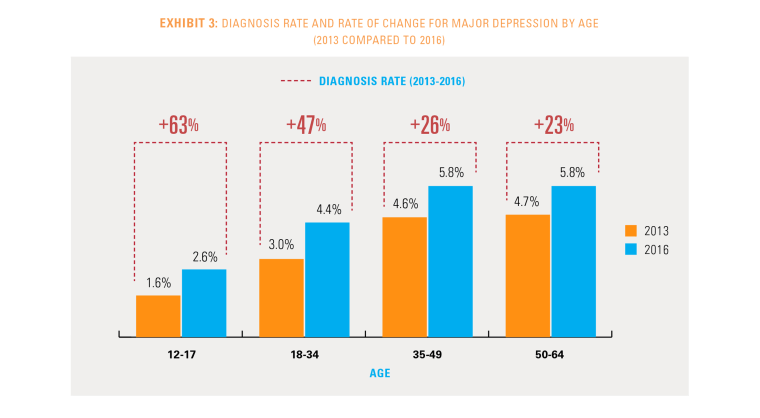
  • Diagnoses of major depression have risen dramatically by 33 percent since 2013. This rate is rising even faster among millennials (up 47 percent) and adolescents (up 47 percent for boys and 65 percent for girls).

  • Women are diagnosed with major depression at higher rates than men (6 percent and nearly 3 percent, respectively).

The report also found that younger generations are seeing the largest increase ind depression rates:

Image: Major depression report

By the way, keep in mind that this data is from among those who have health insurance – and we know that there are millions of Americans who do not, and those in poverty are more likely to be depressed…so this is an underestimation.

This is a genuinely terrifying. We should all be deeply, deeply worried about the findings of this report, findings that, unfortunately, ring true.

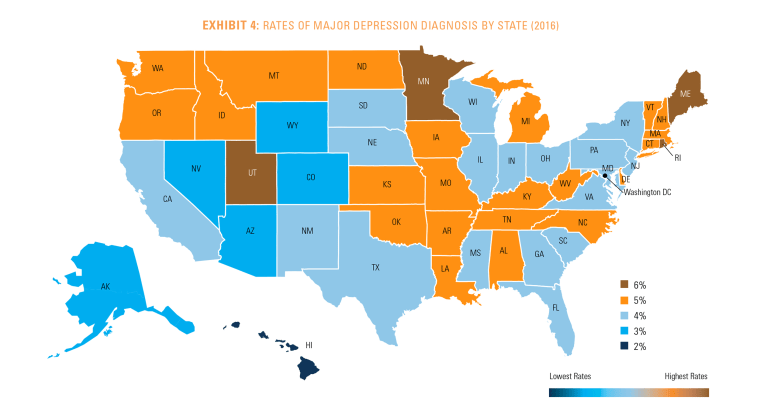
Also worth noting: Rates of major depression vary significantly on a state by state basis:

Image: Major depression report

The NBC article on the subject referred to a variety of potential causes for the increase, including:

  • An increasing sense of business in our day to day lives and a loss of community that comes with it.
  • Overall world events and our increasing awareness of the trauma that exists…everywhere.
  • Social media.
  • Overdependance on smart phones.

We’re going to have to start treating depression for what it is: A major public health crisis. I won’t pretend to be fully capable of developing every solution – and certainly not solutions which are politically viable (treating mental health for everyone requires infusing billions of dollars into the mental health system, and we’re not doing that anytime soon, sadly). And I’ll add this: Many of the items which would really reduce depression are societal and cultural changes that are largely beyond the reach of government. They include things like slowing own our daily lives, increasing family and community bonds, and taking our phones and throwing them out the window.

But the fact is this: We have to do better. As I write this entry I am staring at my children and I worry, given this world and their genetic predisposition, that this will be them one day. Families have to now constantly be on the lookout for potential mental health problems. They have to teach coping skills and resilience, and they have to be willing to seek treatment when symptoms of mental illness/depression begin to display themselves. I wish I’d realized this when I was younger – early treatment for mental illness – like for most illnesses – is critical.

My mission with this blog is largely to discuss mental health and raise awareness. It’s becoming apparent that this awareness is more needed now than ever.

The most common age group to complete suicide is not what you’d think

For obvious reasons, you cannot discuss mental health without discussing the tragedy that is suicide. According to the American Foundation for Suicide Prevention, we lose nearly 45,000 Americans a year to suicide, making it the 10th leading cause of death in this country.

My experience when it comes to suicide and age is this: Most folks, generally speaking, think that suicide is something that primarily strikes younger kids, particularly those in high school. I think there’s a few reasons for this. First is suicides portrayal in popular media, such as the Netflix show 13 Reasons Why. This is just a personal hypothesis, but I think that those who are younger have broader communication skills – as a result, when a young person attempts or completes suicide, you are more likely to hear about it.

Interestingly, this assumption is not born out by the data. According to the American Foundation for Suicide Prevention, here is a breakdown of suicide completions by age:

Suicide By Age

As you can see, the most likely group to complete suicide is not teens or young adults; it’s actually those aged 45-54, followed by individuals who are 85 or older.

What is very frightening, however, are the overall trend lines. For far too many of these age groups, suicide completions are on the rise, and have been for some time. But no where is this trend more pronounced than among those who are between 15-24, which have seen a nearly 20% spike since 2012, a rate of increase far outpacing those in other demographic groups.

There are many potential reasons for this, including rising rates of depression and anxiety among teens in general, the use of smartphones ad cyberbullying that comes with social media.

Regardless of the reason, the trend line is obviously incredibly disturbing, but it remains vitally important that we deal with suicide for the public health crisis it is among all age groups.


Talk to the kids: Why you should tell your mental health story

This past Friday, as part of the real job, I had the pleasure of attending career day at one of my local elementary schools. During that time, I spoke with about 70 5th graders about what it’s like to be a State Representative, what I do, what my issues are, etc. In doing so, did what I always did: I spoke about mental health. I also made sure to be very clear – no euphemisms, and no sugar-coating. I spoke about having depression and anxiety disorders – what that means – and how I see a therapist as needed and take medication on a daily basis.

I make this part of an overall anti-stigma conversation. If I’m talking to younger kids, I broach the subject like this:

“Okay, let’s say you’re riding you’re bike, and you fall off and your arm is hanging at a funny angle.” (imagine me holding my arm at a funny angle) “What’s the first thing you are going to do?”

“Cry!”

“Yes, well, there’s that, but AFTER that.”

“Call 911!”

“Right! Exactly! You’ll call 911! And you would’t even think about it, right? You wouldn’t be embarrassed. Well, imagine having a mental illness….”

And I take it from there.

Sometimes, the kids ask me questions about this stuff. Other times, they delve into other areas of my career. In two of the three classes I had, the mental illness did come up. I was asked questions about it, and they were strikingly perceptive. Two that stick out in my mind:

  • Is suicide a mental illness?
  • Is it a mental illness if you do drugs?

And then a few kids opened up and discussed their own experiences – or that of their family – with mental illness. I know no one would be able to identify them from this, but I’d still rather not say what they said. Suffice to say – it struck me. It left a mark. And it reminded me of one of the many reasons I always discuss my mental illness, but particularly with kids: It can give them a little bit of hope. As many of you unquestionably know, one of mental illness’ greatest challenges is the way it warps your mind, makes you feel like you are alone. I want all of these kids to know that they aren’t alone.

This leads me back to my main point: Tell your story. Please understand I say this not to toot my own horn, but the smartest decision I have ever made in my life was to publicly discuss my own struggles with depression and anxiety. The experience has become astonishingly positive, and has helped me help other people. According to research, a contact-oriented strategy, one in which regular people share their own struggles with mental illness, can be invaluable towards fighting the stigma that keeps people locked in shame and out of treatment. Telling your story can provide incalculable hope to others who need it.

As always, I’d love to hear your thoughts and perspective. Have you “gone public” with your struggles? What has your experience been like?