The tragic suicides of Kate Spade and Anthony Bourdain

I just dropped my kids off at school. I swear, I literally just dropped them off at school, and said to myself, “When I get back, I need to write a blog entry about Kate Spade’s suicide.”

I sit down at my computer. I open the internet. And I see this: Anthony Bourdain, CNN host of “Parts Unknown,” killed himself in Paris. He was 61.

I wish I had the adequate words right now to express how I feel. More life lost to an illness that continues to haunt us, and one that far too many cannot fully understand.

A few points, I suppose, as I try to gather my thoughts.

  • If you need help, there are so many resources available to you. Call a friend, a colleague, a teacher, a loved one. And never, ever hesitate to call the National Suicide Prevention Lifeline at 1-800-273-8255.
  • Suicide knows no limits. No boundaries. It doesn’t care who you are or how successful you may be. People like Kate Spade and Anthony Bourdain seemed to have it all – money, fame, family. They seemed to have access to everything most of us could ever dream of. But the tragic truth is that none of that means a damn thing if you are in pain. The mind and the heart are disconnected from reality in the case of mental illness. That makes their suicide’s all the more shocking and painful to us all.
  • Please, please, watch how you discuss suicide. Avoid phrased like “committed suicide” or “completed suicide” – try to use “killed himself/herself” or “died by suicide.” For my friends in the media, here are some excellent recommendations.
  • The suicide contagion effect is real: A prominent suicide will often serve as a trigger for more, particularly within similar demographic groups. Please, watch your friends.

All of us have a responsibility to watch for each other – to care for each other. If you know someone who is in pain, care for them. Call them. Tell them you love them. The only way any of us survive us with each other. A mere phone has the potential to save a life.

Take care of each other. Today and all days.

The dream scenario: How society should treat mental health

Many of us, including me, regularly talk about how important mental health is. We talk about how important it is that, as a society, we change the conversation around mental health. Something occurred to me as I was debating what to write: I had no idea what that specifically meant. I mean, I have some general ideas, but I want to take a minute to expand upon what I’m talking about – what I mean – when I say that we have to have better and more helpful conversations about mental health in this country.

What do I want? Easy.

  • No one blinks about seeking treatment for mental health. There is no shame, no stigma. You say “I have depression” with the same breath that you say “I have the flu.” In my dream world, no one is afraid to talk about having an anxiety attack. No one is afraid to say they are having a bad day. In our current society, fear of being “discovered” creates more anxiety, more depression, more stress. That, in turns, has a dramatically negative impact on mental health and creates a vicious cycle. We shouldn’t be afraid about discussing who we are and the repercussions that may come with it.
  • There are no barriers to seeking treatment for mental illness in terms of finances or access, and I mean this in a few ways. First, like many areas of medicine, there is a major shortage of mental health care practitioners. This is a major problem and one that exists for many reason, but I’d argue that the chief problem is money. Physicians go into fields for many reasons, and those reasons are similar to decisions that the rest of us make: They are often financially based, and reimbursement rates for psychiatrists are far too low. This keeps doctors out of this vitally important field, and I’d argue that these rates are too low because we are too afraid of talking about mental health to begin with. Insurance companies often create plans that have different and lower levels of reimbursements for mental health care. That leads to worse mental health, and worse outcomes.
  • In my dream, as a society, we’ve stopped even hesitating about talking about mental illness. One of the things I learned quickly when I started talking about my own depression/anxiety? It’s everywhere and everyone. No, obviously every person in the world isn’t mentally ill. But just about every person in this country knows someone with mental illness. After all, one in five Americans suffer or will suffer from mental illness. We have to acknowledge this pain if we are ever going to cope with it.
  • There are no disparities in healthcare among various demographics. I’m lucky; I’m a relatively well-off white male with easy access to health care. While I’m grateful for my own circumstances, we have to acknowledge that other groups – including racial minorities and members of the LGBT community – lack the easy access that I and others like me are fortunate enough to have. This isn’t fair, and it isn’t right. A society is only just when everyone has the same access to life-saving resources.

There’s more – so much more – but these are the first things I’ve come up with. I’d love to hear from you – what else am I missing? Let me know in the comments below!

The book did a cool thing! The book did a cool thing!

As you can see from that picture, I am currently beside myself.

The book is selling – it is selling well – and is currently NUMBER ONE in new releases in a topic near and dear to my heart: Teen & Young Adult Mental Illness Fiction eBooks.

For whatever it is worth, to those of you who are sad, who are depressed, anxious or alone: I was once so depressed I thought killing myself might be the only option to move forward. I’ve learned how to live my life and turned my depression into a good story. Redemption, a story about depression, anxiety and saving the world, is inspired by my own darkest moments. It may now make a difference because I tried to find a way to live.

Please remember that in your own worst days.

Order today from Amazon
Order today on the Nook
Order today on iTunes
Order today from Kobo
Order today from Smashwords

To order a print copy directly from the author, follow this link (it wills say “Pocket Protector Games but that’s just the name of my LLC, I promise!).

Twenty young people wake aboard the spaceship Redemption with no memory how they got there.

Asher Maddox went to sleep a college dropout with clinical depression and anxiety. He wakes one hundred sixty years in the future to assume the role as captain aboard a spaceship he knows nothing about, with a crew as in the dark as he is.

Yanked from their everyday lives, the crew learns that Earth has been ravaged by the Spades virus – a deadly disease planted by aliens. They are tasked with obtaining the vaccine that will save humanity, while forced to hide from an unidentified, but highly advanced enemy. 

Half a galaxy away from Earth, the crew sets out to complete the quest against impossible odds. As the enemy draws closer, they learn to run the ship despite their own flaws and rivalries. But they have another enemy . . . time. And it’s running out.

Six questions: Kristy Acevedo, author of Consider

So, on the heels of my book coming out yesterday, here’s another author interview for you, and this one was kind of fun. This book is called Consider, by Kristy Acevedo. It’s part of the portals series, which does something that I wish more authors did: It discusses mental illness/anxiety attacks from a science fiction perspective. Interested? Read on for more!

1) Ah ha! Your book is one of the rarer ones that gets out of a typical YA-genre while still addressing mental illness. What made you deal with anxiety disorders in such a way?

One of my overall goals when writing CONSIDER and CONTRIBUTE was to create a realistic teenager with an anxiety disorder who has to deal with a sci-fi phenomenon. I wanted her honest struggle and the complex relationships in her life to give the story a gradual depth that would hit at gut level. Alexandra is strong, vulnerable, compassionate, and flawed, and becomes heroic. To do this, I decided to write in first-person, present tense, which was a struggle to maintain for the entire series. It was worth it to give Alexandra’s character the focus she deserved.
 
2) Minus the hologram part, is your book based on personal experiences with anxiety that you have shared? How did those experiences inform your writing? If not, how did you learn how to write about anxiety in such a credible way?
All the anxiety in the book is based on experience, not research. While I don’t have an anxiety disorder, I have several close family members with mental health issues, mild to severe, and over the years I’ve been their advocate during panic attacks, hospital visits, etc. With permission, I’ve combined several experiences to inform Alexandra’s unique character. I wanted to write a character struggling in a realistic way, who also shows tremendous courage and strength and becomes the hero of the series, because that’s how I see those people in my life, even if they don’t always see themselves that way.
 
3) What kind of feedback have you received from people with anxiety disorders about your book?
I’ve gotten many emails about how much they connected with Alexandra’s anxiety, and how, even though the series gets sinister and tragic, they felt a sense of hope witnessing her grow as a hero. They thanked me for portraying her character with no sugar coating and no sudden cures. Some readers said they had to take breaks while reading since her anxiety was so accurate, it triggered theirs. I apologized for that, and they reassured me that meant it was so good.
 
4) This is completely random, but you are a teacher. Do your kids ask you about your writing often? How do you bring it up as you teach?
 
On the first day of school, I introduce myself and my journey to becoming a professional writer. Then I tell students I will never bring up my books again during class unless they ask me a specific question. I tell them I am first and foremost their teacher, not their author, and that I don’t want to be that obnoxious person always talking about my work. Usually, they nod and laugh and respect that I’m here for them.
 
They tend to only bring up my books during writing assignments. Some of them are intimidated at having an author as their high school English teacher, worried that I’m going to “grade them harder.” I reassure them that I’ve been teaching for almost twenty years, and I know how teenagers write. I also model drafting with them, writing crappy opening paragraphs and asking the class to edit me, and that usually empowers them to see that even published authors struggle to write. Or when I’m reminding them how important brainstorming or outlining is, someone will ask, “Do you do that for your books?” So I will explain what works for me and show them samples.
 
And sometimes, a student will come after school dying to talk to me after reading my books, and that’s incredible to witness in real time.
5) What is your advice to authors who want to write in a more inclusive way about a whole slew of topics/characters – be it ethnic diversity, LGBTQ, physical disabilities, mental illness – but don’t actually have the personal experience to discuss the issue?
 
Support marginalized writers and amplify their voices. That should always come first.
I know writers want their stories to reflect the world around them, but they need to ask themselves if they can bring diverse characters to the page authentically and without harm to those communities. You shouldn’t be writing diverse characters if you spend most of your time in a non-diverse community. So my advice would be to diversify your life before diversifying the page.
6) Portals. Why portals????
Why NOT portals? Hahaha! I was binge-watching Doctor Who when I got the idea for the Holo series. Since Doctor Who is all about traveling through time, it was inevitable to end up with some sort of portal element.
If you enjoyed books that discuss science fiction and mental health, I hope you check out Redemption, my YA/Science Fiction novel about depression, anxiety and the end of the world.

Redemption – my book – is now available

Today’s the day. A really, really big day, for me. Today, my book, Redemptionis available for order.

First, the logistics: If you pre-ordered it on your Kindle, it should be there! If you want to order it for Kindle or order a print copy on Amazon, go right to the website. To order it in other formats, or to order a printed copy directly from me (which I will sign and ship!), visit my website. Also, if you use Goodreads, you can check out the book’s page here.

Again, here’s what the book is about:

Twenty young people wake aboard the spaceship Redemption with no memory how they got there.

Asher Maddox went to sleep a college dropout with clinical depression and anxiety. He wakes one hundred sixty years in the future to assume the role as captain aboard a spaceship he knows nothing about, with a crew as in the dark as he is.

Yanked from their everyday lives, the crew learns that Earth has been ravaged by the Spades virus – a deadly disease planted by aliens. They are tasked with obtaining the vaccine that will save humanity, while forced to hide from an unidentified, but highly advanced enemy.

Half a galaxy away from Earth, the crew sets out to complete the quest against impossible odds. As the enemy draws closer, they learn to run the ship despite their own flaws and rivalries. But they have another enemy . . . time. And it’s running out.

Okay. Now for the personal stuff.

This book was written during one of the ugliest, most depressed periods of my adult life. I was in a bad funk, my wife was having a hard time at work, and we were both just struggling. I had started seeing my therapist again, I had increased my medication, but I was still in a really bad way. And I made a decision that I needed to do more, and remembered how writing had saved me when I was a teenager. I’d already written a non-fiction book – Tweets and Consequences – and while I’d enjoyed that process, I wanted to do more. I wanted to write something that was truly meaningful to me on a personal level.

Twenty years ago – probably more – I had this idea as a young teenage writer about kids winding up on a spaceship with no idea why. While I was thinking about writing, I remembered this kernel of a plot. I wanted to write about mental illness as well, since that cause has become such a part of my life.

And thus, Redemption.

As for why this is so important to me. Please understand that this isn’t just a book. It’s difficult to explain how meaningful writing this was on a personal level. The best way I can put it is this: When you write, if it is about an issue that you really care about, you’re not just creating words. You’re putting a piece of your heart out for the world to see. This book is a huge piece of who I am and my personal mission of helping people who suffer from mental illness find hope and recovery. I hope this book can do for others what it did for me – help pull me from the darkness. I hope it can help people realize that they can live good lives, even with depression, anxiety and mental illness. And I hope it’s a good read.

Anyway, world, meet Redemption. I hope you enjoy it!

Interview: Not Another Anxiety Show

Hey folks – a quick entry here, just wanted to share a podcast interview I did for those of you who are interested. Thanks to Kelli over at Not Another Anxiety Show for hosting me on her podcast, where we discussed mental health, politics, and I miiiiiiiiiight have mentioned the book I have COMING OUT TOMORROW.

Here’s the show. Enjoy!

The language of suicide, and why it matters

As you may have noticed, whenever I discuss suicide on this blog, I’m always very careful on how I phrase it, although researching this blog entry has made me realize that I’ve been messing this up to. There are words and phrases you should and should not use when describing suicide – here’s a quick overview about some best practices.

Why “committed suicide” is bad

This one is more obvious and stigma oriented. Simply put, “committed” is used to describe a crime. Someone committed a murder. They committed a robbery.

Committed, in this context, is usually associated with a moral judgement, and that’s not a way that any of us want to describe suicide. Suicide and mental illness shouldn’t be associated with a moral failing. Doing so can make people who suffer feel weak or ashamed, and that can serve to increase the stigma that surrounds both mental illness. The language we use should encourage others to seek help, not drive them into a closet of fear and shame.

Why “completed suicide” is also bad

This is the phrase I’d always used – I viewed it as preferable – but this is a really good point:

Think of the sense of accomplishment you feel when you complete a big project. Then think of the disappointment you feel when you don’t.

Completion is good, and suicide isn’t.

To complete something conveys success; to leave something incomplete conveys failure.

Indeed, we do associate completion with success, and no one’s suicide should be viewed as a success. So, there must be something else.

The alternatives

I think the AP is on track when it comes to these alternatives. The phrases used here are preferable, in that they are accurate and avoid the moral connotations that comes with “completed” and “committed.”

Language matters. Words matter. We know that the way we describe an action can unintentionally pass judgement over the action and can increase or decrease the stigma that comes with it. All of us have an obligation to be careful in the way we talk, and I’m going to be better at this from now on.

And one more thing: In our society, there’s been a backlash against being “politically correct” when it comes to how we describe things. My experience has been that this backlash is more orientated around being a decent and non-racist person, but that’s besides the point.

The way we discuss suicide has nothing to do with political correctness. It has everything to do with creating an environment that makes people feel safe, that supports (rather than harms) their mental health, and that can increase the odds of someone seeking help instead of ending their life.

Any thoughts you want to add? Any other language recommendations? I’d love to hear them – please let us know your thoughts in the comments!

Three ways social media can be good for your mental health…I guess….

Despite my own personal obsession with social media, I have written repeatedly about how bad it can be for your mental health. That being said, I remembered something the other day: Social media changed my life in a very important way. It was through someone else’s stupidity, but that still counts!

Allow me to refer to a blog entry last week:

Let me go backwards. Robin Williams completed suicide on August 11, 2014. He had long suffered from a slew of mental health challenges, including depression and substance abuse. However, Williams was suffering from “diffuse Lewy body dementia,”which ultimately contributed heavily to his suicide.

William’s suicide ultimately inspired me to go public with my story. That started when some idiot on Facebook decided to spout off shortly after Williams’ death by saying something along the lines of, “So sad Robin Williams committed suicide. He just needed to pray to Jesus more!”

No, you schmuck, that’s not how it works, and that ignorant comment got me so damn fired up that I wrote an op-ed in my local paper, detailing my own struggles with depression, anxiety and suicidal ideation. That, in turn, set my career in motion in a very different way, making me become much louder about mental health issues. I’ve spoken at events detailing my own struggles, cofounded a mental health caucus, appeared in PSAs and introduced legislation designed to help those who are suffering from mental health challenges. I know that the work I’ve done in this realm has helped people – and I know I have a lot more to do to help more.

As much as I hate to admit it, while thinking of this moment the other day, I realized something: It happened because I was on Facebook at that one specific moment. If I hadn’t been, I would never have had this very positive, life-changing experience. My life would be dramatically worse.

So, even I must admit: Social media can be good for your mental health.

How else can it be helpful? Here’s a few thoughts, but with an important caveat: It all depends on the users. Social media can be good for your mental health, but that only occurs if you are willing to approach it from a certain perspective and/or change your way of thinking.

1) Social support: I firmly believe that social media cannot replace real-world interactions – but that’s not to say that they don’t have a place. Social media can help people feel connected to each other if people join supportive groups, develop healthy relationships and give as much as they take over the course of regular conversations. It can also make it easier to discuss important problems:

A common dilemma among people with mental illness (including depression) is the reluctance to talk to people closest to them about their problems. More and more young people are turning to the Internet for health advice, including topics such as contraception, acne treatments, etc. Far from being a singularly-destructive force in their development, social media can, in fact, do quite the opposite.

This is the opposite of the unrealistic expectations that haunt so many on social media. Instead of making people feel more isolated, it makes them feel more connected – and less alone.

2) You can get closer and learn more about people you’re already friends with: My wife and I have a running joke that, whenever we go to a public event, someone will say something to me about my most recent Facebook post. I try to return the favor whenever possible. Social media – when used to strengthen real world relationships – can be very helpful.

3) You can actually learn something: We’ve all seen it – the political conversation that isn’t really so much a “conversation” as it is “two idiots yelling at each other and accomplishing nothing other than polluting your Facebook wall with their mind garbage.” Social media isn’t always the most conductive place to have a political conversation – but, imagine, for a moment, that you approach a political debate with a different perspective. A willingness to listen and to learn. It is possible to actually learn something from social media debates if you can change your mindset and approach these conversations with an open mind. Maybe you won’t be convinced of someone else’s viewpoint, but hopefully, at least, you can better understand their perspective, and that’s exceptionally important in today’s fragmented society.

As always, I welcome your thoughts. What am I missing here? Let us know in the comments!

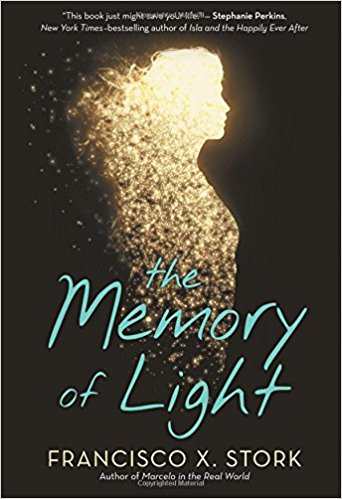
Six questions: Interview with Francisco X. Stork, author of The Memory of Light

I have to be honest here: This one I came across in the course of doing research for these interviews, and I was so interested in the plot I read it. It was gripping, heavy, painful and beautiful. It’s absolutely worth reading.

From the blurb:

“When Vicky Cruz wakes up in the Lakeview Hospital Mental Disorders ward, she knows one thing: After her suicide attempt, she shouldn’t be alive. But then she meets Mona, the live wire; Gabriel, the saint; E.M., always angry; and Dr. Desai, a quiet force. With stories and honesty, kindness and hard work, they push her to reconsider her life before Lakeview, and offer her an acceptance she’s never had.

But Vicky’s newfound peace is as fragile as the roses that grow around the hospital. And when a crisis forces the group to split up, sending Vicky back to the life that drove her to suicide, she must try to find her own courage and strength. She may not have them. She doesn’t know.

Inspired in part by the author’s own experience with depression, The Memory of Light is the rare young adult novel that focuses not on the events leading up to a suicide attempt, but the recovery from one — about living when life doesn’t seem worth it, and how we go on anyway.”

Here are six questions with Francisco X. Stork, author of The Memory of Light.

1) Your book is heavily inspired by your own experiences with depression. What made you decide to “go public,” so to speak, with that experience?

The decision to connect the story in The Memory of Light to my own experiences was made shortly before the book went into production. It was then that I wrote an author’s note where I mentioned my own life-long struggles with depression and with a suicide attempt when I was in graduate school. I had talked about my depression and bipolar disorder in my blog before, but it was the first time I talked about the suicide attempt. I realized that there was still a lot of shame and guilt associated with that and I thought that I should try to confront that shame and stigma, just like the characters in my book. I also wanted the readers of the book who were suffering from depression or considering suicide, to know that I understood in a very personal way what they were going through and that the hope and light offered by the book was hard-earned and genuine.

2) How much of you can be found in your main character?

One of the reasons I made my main character, Vicky, a young woman is that I thought it was important to create some separation from my own experiences and the main character. If the character had been male, I would have a tendency as I wrote to see myself as the main character. The distance between me and Vicky gave me the ability to filter my own experiences and feelings and transform them into those of a sixteen-year-old young woman and to express these feeling the way she would. Of course, there is a lot of me in Vicky. But the novel is not a memoir and so what mattered was the creation of a unique character that would be real in the heart of the reader.

3) Much of your book seems to deal with the resilience – the ability of the main character to cope. Did your book consciously attempt to teach readers how to build their own resilience? 

For many of us, even with medication, depression is a chronic condition and even when we are “well”, it is always there lurking beneath the surface. So “resilience” or the ability to cope and to live useful and peaceful lives despite of it, is an important goal. This requires that we let go of images of “happiness” that our society gives us and that we create our own realistic version of a life that contains joy and meaning despite depression.

4) How was The Memory of Light therapeutic for you? Or was it? Did you find it dredging up old memories?

I’m not sure “therapeutic” is the right word. The book did not cure my depression or necessarily make me feel better for expressing heretofore hidden truths about myself.  When you seek to write fiction as opposed to memoir, the goal is to create an experience for the reader, something that touches him or her in a real way. The benefits for the writer, when fiction is done well, is the unforeseen discoveries about self and the world that the writing brings about. I understood and saw things about the illness of depression and how to live with it, that I had not understood and seen before. I felt less anger toward my own depression and was able to see the negative moods that come with depression with less condemnation and judgment and with a greater awareness that these negative states were not permanent.

5) What do you think readers can learn from your book about depression and recovery?

My hope is that in the process of reading the book, the reader will become involved with Vicky and the other characters in the book and grow to care for them. If that happens, there will be a good chance that the reader will be able transfer that same care and love to him or herself. The horrible thing about depression is the feeling that we are not good enough, that we are not worthy of all the good that life offers. But when you see a character like Vicky slowly learn to accept the good in her and in others, then it will be easier for us to feel the same about ourselves and about others.

6) The book is now about two years old. Anything you wish you had or had not done with it?

The Memory of Light took me a long time to write and I went through various drafts making sure that the final product would be one that offered hope to a person who was considering whether life was worth living. I’m happy with the book as it is. During the past two years I’ve heard from young people who were touched by the book and found light and hope because of it. That is what I hoped the book would do. The book is no longer mine. It belongs to the reader.

If you enjoy books about young adults and mental health, then I encourage you to check out my upcoming novel, Redemptionwhich will be out on June 5 but is available for pre-order at a discounted price today. Redemption is a young adult/sci-fi thriller about depression, anxiety and saving the world.

Depression and meditation

Ugh, just writing this article makes me a little depressed. Why? Well, cause I can’t stick with this. No matter how hard I try, I absolutely, positively cannot stick with meditation – and that’s despite the evidence I’m about to write about below.

The studies are clear and I have written about the subject before: Meditation helps with depression. According to one study published in The Lancet, meditation may be as useful as anti-depressants at keeping depression at bay (side note: Damnit! I really need to look at this again!). This study noted the benefit of mindfulness meditation, which is a specific type of meditation.

What is mindfulness meditation? Mindful.org describes it simply: “Take a good seat, pay attention to the breath, and when your attention wanders, return. By following these simple steps, you can get to know yourself up close and personal.”

Want to know more? I found a few interesting resources on the subject. First, there’s this, from Headpsace, a meditation app I’ve used before. The article details the struggles of a very depressed man who tries meditation in a desperate attempt to get some relief and how meditation changes the way he thinks. The Washington Post ran a similar story earlier in the year, in which the author discusses how the Headspace app (this isn’t a sponsored post, I swear) helped them relearn their thinking.

Want more info on the research behind meditation? Check out this article on Mindfulness-Based Cognitive Therapy, which is a specific type of meditation designed to help those with depression.

If you’re interested in more information on how meditation may help people with anxiety and depression, look at this pretty fascinating article from Harvard, which details specifically how depression can physically change your brain.

I will say this: As I’ve bitterly noted repeatedly, there have been many instances where I have actually meditated with some regularity, only to stop after some period of time. But, during those times, I did notice some changes about the way I was thinking. Specifically, I found myself focusing less often on anger, frustration and bitterness. I found myself better able to let things go, and it felt great. Sadly, inevitably, a busy life caught up with me, and I let the practice fall away.

Time to try again!

As always, I conclude with a question: What has been your experience with meditation? Have you practiced it – or do you practice it – on a regular basis? Notice any changes that you want to share with us? Please tell us your story in the comments below!