Blog

The importance of the human touch to prevent suicides

I wanted to talk a little more today about a study which – if the findings are replicatable – could go a long way towards proving that the best way to prevent suicide may be simply showing that you are someone who cares.

The study itself took place in Australia and was run by Dr. Gregory Carter of the University of Newcastle. Carter and his team sent suicide-attempt survivors a postcard eight times over a 12 month period.

The postcard didn’t say much, and it wasn’t fancy. On the front, it had a cartoon dog with a letter in its mouth. On the back was this message: “Dear X, It has been a short time since you were here at the Newcastle Mater Hospital and we hope things are going well for you. If you wish to drop us a note we would be happy to hear from you.” the card also had contact information for two doctors and the hospital.

The results? The group who received the card showed a 54% reduction in future suicide attempts, but the effort worked only for women.

Intuitively, this makes sense, of course. It’s no surprise that social contact and relationships are a preventative factor when it comes to suicides. And showing someone that you care can, of course, make a huge difference. How many times have you heard of a case where someone came back from the edge simply because there was one person who cared deeply about them?

This isn’t a silver bullet, of course. But it does reiterate a basic and sensible human truth: We can pull people back from the edge if we just show them that they care, that they matter, and that there are ways to get help if they are feeling down.

I’d also argue that this shows that all of us have a role to play when it comes to suicide prevention and helping people get through their darkest moments. To be clear, again, none of us are responsible for someone who ends their own life – but all of us can be part of a solution. Care for each other. Follow up with friends who are showing warning signs of depression or suicide. Ask if they are okay. You don’t have to have the solution. But just being a caring human can, apparently, go a long way towards preventing someone from taking their own life.
 

Oregon students can now take mental health days

So, in my political world, I’m a pretty progressive guy. One of the states which I have always watched closely has been Oregon. Oregon has been a progressive success story of epic proportions: From the environment to minimum wage increases to abortion rights to gun control to expanding economic opportunity to all residents, Oregon has led the way. 1

And then, I came across this story: Teens in Oregon can now take mental health days as an excused absence from school. It was done largely to address the stigma which surrounds mental health. According to Debbie Plotnik of Mental Health America:

“The first step to confront this crisis is to reduce the stigma around it. We need to say it’s just as OK to take care for mental health reasons as it is to care for a broken bone or a physical illness.”

The law specifically states that students can have up to five absences in a three month period – and anything more requires a written excuse to the principal.

In response to concerns that the law would make it easier for students to get out of school, Haily Hardcastle, one of the teenagers involved with the lobbying for the law, said, that students would take time off with or without the law – but the new law may encourage students to take their own mental heath more seriously, and would require schools to recognize mental health in their attendance policies.

Oregon’s rate of suicide is 40% higher than the rest of the nation.

I’m…I’m really intrigued by this. It does seem like a lot of days. And I wonder how this effort would interact with other attempts to remedy chronic absences – something that we really struggle with in my home school district of Allentown. But, I believe that Mrs. Hardcastle’s comments are correct – a kid is gonna take a day off if they want to, and if we can encourage them to discuss why, maybe we can help save their life.

Regardless, I’m extremely intrigued, and I’m hoping to pursue this one more. And if you have any feedback, I’d love to hear it!


Netflix removes controversial suicide scene from 13 Reasons Why

13 Reasons Why is a Netflix series based on the popular book by Jay Asher. The book deals with the aftermath of the suicide of Hannah Baker, who then sends tapes to people involved in her life, detailing the reasons behind her suicide.

The show was then turned into a hit Netflix series, which generated a ton of controversy for a variety of reasons, chief among them being the graphic depiction of Baker’s suicide, which features Baker, in the bathtub, slitting her wrists, crying in pain and ultimately bleeding to death.

I’d written about the show before, and mainly in terrible terms: It’s premier had been tied to a rise in suicide among 10-17 year olds, and the graphic depictions of Baker’s suicide seemed to violate every best practice of reporting on suicide.

Netflix – in response to the controversy – has changed the season finale of Season One, which featured this scene: It has now been been completely removed. In a statement, Netflix said:

“We’ve heard from many young people that 13 Reasons Why encouraged them to start conversations about difficult issues like depression and suicide and get help — often for the first time. As we prepare to launch season three later this summer, we’ve been mindful about the ongoing debate around the show. So on the advice of medical experts, including Dr. Christine Moutier, chief medical officer at the American Foundation for Suicide Prevention, we’ve decided with creator Brian Yorkey and the producers to edit the scene in which Hannah takes her own life from season one.”

As the Hollywood Reporter noted, a variety of anti-suicide groups praised the removal in a joint statement.

The damn shot should never have aired. In prior statements, show creator Brian Yorkey had said that they didn’t want to make suicide look peaceful and thus glamorize it. I get that. And – if you assume that they were operating with the best of intentions – I get that they were trying to make it seem realistic and less abstract.

But, as Vox notes, that’s exactly the problem:

The theory is that for people who struggle with suicidal ideation, anything that can make suicide feel more familiar to them and cause them to keep thinking about it can be dangerous. That’s part of what leads to suicide contagion, the phenomenon in which media coverage of a death by suicide can lead more people to die by suicide.

As I argued in my entry earlier in the week, we have to be very, very careful with how we discuss suicide, lest we inadvertently plant the idea in someone’s head that suicide is somehow acceptable or “freeing.” While the type of discussion which occurred here is different than the blog entry I was writing about, the concept is the same: Be careful in how you discuss suicide, particularly given the way it could impact the most vulnerable of people.

I’m glad Netflix did this. But the show has generated controversy because their is evidence to suggest that it is correlated with more people dying by suicide. That’s a major problem, and they need to do better.

Suicide is never “gotta set myself free” – a letter to Epic Rap Battles and a discussion on how we talk about suicide

Sunday entry instead of a Monday one, but it’s an important and timely one.

If you are a nerd like me, and you’ve spent any time on YouTube, chances are you have come across Epic Rap Battles of History. They are a YouTube channel which hosts rap battles between historical or celebrity figures. They lampoon everyone, and they are so, so clever and funny. I’ve always loved them and get excited when they publish a new video.

Early this morning, they premiered their latest battle between George Carlin and Richard Pryor. The battle, as usual, was hilarious. This one featured guest appearances be Joan Rivers and Robin Williams. Williams appears last, and it’s his last line which causes the problem:

Again, that last verse:

“I love the prince
but you’ll never have a friend like me
Thanks folks that’s my time
Gotta set myself free”

And Williams disappears into the top of the screen.

That last line is clearly a reference to William’s suicide in August 2014. And that line is a huge problem. Suicide should never, ever be discussed as a freeing option, one which somehow frees people from the bonds of pain and life. Suicide is not an option. Discussing it as a positive thing frames it in a positive way, and that encourages others to look at suicide as if it should be considered.

Some of you may remember that this isn’t the first time that William’s suicide was displayed this exact way, using the same language (which is a reference to both the suicide itself and Genie’s desire to be free in Aladdin). After William’s suicide, The Academy of Motion Picture Arts and Sciences put out this tweet:

The tweet was criticized by suicide prevention activists. It made suicide appear celebratory, a victory over depression and pain, and a viable option for anyone who hurts. This can never, ever be the case.

From the article:

  • Christine Moutier, chief medical officer at the American Foundation for Suicide Prevention: “If it doesn’t cross the line, it comes very, very close to it. Suicide should never be presented as an option. That’s a formula for potential contagion.”
  • Ged Flynn, chief executive of the charity Papyrus: I am particularly concerned that use of the ‘Genie, you’re free’ tweet could be seen as validation for vulnerable young people that suicide is an option.”
  • Jane Powell, director of the support group Calm, “We all want Robin to be in a happier place but it’s not a good message for people feeling suicidal, because we want them to stay with us and not go find some starry night escape with genies,” she said.

This is needed largely because suicide contagions are real: After William’s suicide, suicides increased by 10%. And, as the study I linked to notes, media coverage of suicide can be critical to how the coverage of suicide influences suicidiality in others. There are media recommendations for how to cover suicide (I actually tweeted it yesterday, before this video, in reference to an ongoing situation in my home region which thankfully ended well).

One of the key recommendations is not to glamorize suicide or present it as an option. The media has failed that before: Epic Rap Battles failed it here. Do I think they did this on purpose? No, absolutely not. I think it’s an honest mistake. But I hope it’s one they correct.

Again, here are the facts:

  • In 2017, over 47,000 Americans took their own life. These are the highest rates of suicide since World War 2.
  • Suicide is the 10th leading cause of death in the United States, and the 2nd leading cause of death for 10-24 year-olds.
  • Suicide rates have increased 33% since 1999.

We have an epidemic, or, in the words of Congersswoman Susan Wild (D-PA), a national emergency. National emergencies require being addressed on all fronts. One of those is cultural and communication. No one with a platform over over fourteen million subscribers should make such a casual reference to suicide and describe it as “gotta set myself free.” I’m hoping this was unintentional. And I hope that ERB will consider changing the video.

And to everyone else: Please watch how you discuss suicide. Please take it seriously. And please use person-first language which ensures that we let people know they are loved and cared for, and that we never, ever, ever want them to “set themselves free.”

The Spades Trilogy & Redemption: An Update!

One of the basic principles of blogging is to not be too self-promotional – say, promote yourself 1 out of every 10 entries. This webpage is hosted on “www.mikeschlossbergauthor.com” so it’s probably no surprise for you to hear that I’ve done this, in part, to help promote my book, Redemption.

That being said, I, err…forgot to promote the book on the blog. My bad.

For those of you who are unaware, I wrote a book! Redemption is a Young Adult, Mental Health, Science Fiction tale on depression, anxiety and saving the world:

Twenty young people wake aboard the spaceship Redemption with no memory how they got there.

Asher Maddox went to sleep a college dropout with clinical depression and anxiety. He wakes one hundred sixty years in the future to assume the role as captain aboard a spaceship he knows nothing about, with a crew as in the dark as he is.

Yanked from their everyday lives, the crew learns that Earth has been ravaged by the Spades virus – a deadly disease planted by aliens. They are tasked with obtaining the vaccine that will save humanity, while forced to hide from an unidentified, but highly advanced enemy.

Half a galaxy away from Earth, the crew sets out to complete the quest against impossible odds. As the enemy draws closer, they learn to run the ship despite their own flaws and rivalries. But they have another enemy . . . time. And it’s running out.

If you’re interested, go here for ordering info (including how to order a copy direct from me), or here to order off Amazon. You can also download the first chapter, absolutely free.

The book came out a year ago, so, let me give an update about what’s next!

The Trilogy

It is the Spades Trilogy, after all, so you may be wondering, where is Book Two?

Here’s the good news: It is actually written. So, yay! My publisher currently has it, and I’m hoping it will enter the editing process in the near future. It required some rewrites to make it a better product, so that slowed things down a bit, but appropriately so: I’d rather get something to you that’s really good than something that’s been done really quick.

I’m not sharing the title yet, but I will, I promise. I’ll say this: The original title was Reclamation. That got changed because it just sounded weird and didn’t work with the theme of the book. Also, my wife made fun of me, saying it wasn’t a real name.

When will it be published? That one I don’t have an answer for. It depends on how long the editing process takes. My guess – and this is just a guess – is at least a year.

And, for the record, Book Three is also written, and I should finish my edits on it within a month or so. So, yes, I know how the story ends. But that one is nowhere near ready for publication.

The writing process is a long one. The first book took four years, start to finish – although that was because I also had to get a book proposal ready and find a publisher. Hopefully 2 & 3 won’t be as long.

Writing about depression, anxiety, Spades, Ash, Alexis & the rest of the crew of the Redemption has been one of the more joyful experiences I’ve had professionally. I love what the book evolved into. It has given me a chance to attack mental illness in a completely new arena, and I have loved every second of it. And I can’t wait for the rest of the story to get share with the world.

4 Quick Tips to Break You Out Of Your Funk

My wife and I spent a lot of time this summer at the our local parks. We’re lucky – we live in Allentown, and we have this ridiculous park system. One of the closest to our house – and the largest – is Trexler Park, a gorgeous park with a lake, ample green space and a few paths. Every night last week, we’ve grabbed the kids and hopped down to Trexler. It’s been wonderful.

And I always feel better when we get back.

Look, one of the many problems with depression is that it totally locks you in. You do the same things because you simply do not have the time or mental energy to do anything else. That, of course, can only lead to more depression issues, and that’s something which you have to try and break if you’re ever going to make a recovery.

There are ways, however. The next time you feel stuck, consider doing any of these 5 activities.

Go to the park

Forget your troubles, try to forget everything. Go for a nice walk and lose yourself in nature.

Yes, this does help – and there’s research to prove it. It’s 8am on Sunday as I am writing this, and I just took the dog for a walk around my nearly deserted block. It felt so nice. The best way I can describe how I feel is more centered.

Volunteer at a nearby animal shelter

Our family just adopted a pupper again, and it’s been very nice so far. We took our time making the selection from the Lehigh County Humane Society, and one of the things which struck me when we were there was that they had a slew of volunteers walking in and out of that place, caring for the animals, taking them for walks, etc.

Look, puppies and kitties are more than just adorable: They help you fight depression. Combine that with the general mental health benefits of volunteering, and this one is well worth it. If you’re an animal person, go check out your local shelter and see what volunteer options there are.

Exercise

I’ve written about this one before so I am repeating myself, but exercise when you are depressed can be very beneficial, and again, there’s research to prove it. Depression is fundamentally biological, and exercise can change your biology and physiology, making you feel better.

Take care of yourself

When I think of myself in my most depressed state, it’s this: Covered in a hoodie, unshowered, hair uncombed and unshaven. Sound familiar? When you’re depressed, you lack the energy or mental strength to do even the most basic things, like take care of general hygiene. That, of course, is largely a mental trick, but it works both ways. Doing something small – even if it’s just brushing your teeth -can signal to your body that this is not where you want to be right now. So, to that end, when you’re down, make sure you take care of your body. Do the basics – shave and comb your hair. If you don’t think you have strength for that, try something small – take a warm shower. Try to fool your body into thinking you are okay – and then look the part.

These are four things which work for me and others, but they may not for you. What does work for you? Let us know in the comments!


An in-depth look at America’s suicide numbers

This Bloomberg story came out about two weeks ago and reviewed America’s rising suicide numbers. It’s findings, as you can imagine, are damning. Some of the salient points:

  • In 2017, 47,000 people died by suicide – and 1.4 million made attempts.
  • From 2000-2006, the suicide rate increased by 1% annually. From 2006-2016, that increased to 2%.
  • Life expectancy has fallen for three straight years – the first three consecutive year drop since 1915-1918.
  • Suicide is the 2nd leading cause of death for 10-34 year-olds.
  • Suicides cost U.S. businesses between $80-100 billion annually.
  • A lack of resources is to blame for many of these issues. According to some experts, the United States needs 50 mental health beds for every 100,000 people – but some states have numbers as low as 5 per 100,000.

The article goes on to say something I’ve discussed in the past – part of the intractability of our mental health and suicide crisis is the intertwined nature of the problems. Health care, genetics, finances, social support, culture – they all interact to influence mental health. As the article notes, combine that with a rapidly changing economy, advances in technology and a changing cultural scene, and you have a recipe for the disaster we’re currently experiencing.

Mental Health parity (reimbursing physical and behavioral health care at the same rates) and a lack of doctors play a role as well. As recent court cases have noted, many insurers still aren’t adequately reimbursing for mental health services, or they are resorting to alternative methods (such as steering patients to doctors who are no longer even in their network) in order to keep people out of treatment.

The story also noted that changing the way we gather data could lead to additional insights which may result in better treatment of mental health disorders: In 2010, England started measuring overall life satisfaction and recently created a “Minister of Loneliness.”

So, what’s the conclusion of this article? Besides “holy crap this is bad”?

I think I’m gonna be repeating myself a bit here. But the conclusion is that addressing suicide for real will require a huge investment of resources and an acknowledgement that it’s more than just mental health. We have to address insurance and fiscal policies. Create a culture which is more accepting of mental health challenges. Understand that the challenges of mental health are comprehensive ones which tie a variety of areas together.

And I think we have to be willing to pay. For care. For insurance access. For bed space in the event that there are emergencies.

I hated reading this article because it was painful. But we need to know the truth about mental illnesses. And the truth is that this problem will take a long, long time to fully address.


The importance of inclusion – for everyone

I caught this article on Facebook the other day – it’s results caught me by surprise (to an extent) but it has a key finding that I really wanted to go over.

In 2014, the University of British Columbia examined the connection between suicide rates and having a Gay-Straight Alliance at High Schools in Canada. The results showed that students were less likely to feel discrimination, experienced lower suicidal thoughts, and have lower rates of suicide attempts.

Just gay students, right?

Wrong. All students.

This is a pretty striking finding. Not only are GSAs positively related to the mental health of gay students, but if the findings of this study are correct, they can also positively impact the mental health of students whose lives would (theoretically) not be impacted directly by the Gay-Straight Alliance.

This is great for many reasons. First, as I discussed last week, LGBT Americans sadly have significantly higher rates of a slew of negative mental illnesses, including suicide. Clubs like GSAs can provide safe places for LGBT teens to congregate, build vitally necessary social relationships and learn they aren’t alone. All of these are mitigating factors against mental illness and suicide.

Intuitively, this makes sense. But the finding that I think is more worth examining is why GSAs are potentially tied to lower suicide rates in heterosexuals. First, a disclaimer: It is worth noting that this study is correlational, not causational. In other words, while lower suicide rates and GSAs appear to be related, the lower suicide rates may not be a direct result of GSAs. Indeed, it is possible that there are more GSAs because of lower suicide rates, or that a third factor (such ass wealth of a school district, education attainment of parents, etc) is tied to both GSAs and lower suicide rates.

However, the fact that both of these items seem related (regardless of the relationship) begs the question: What is the relationship between a more tolerant society for everyone, not just the directly affected groups?

This is one worth thinking about, because it can help change the frame of how we view ideals like inclusion an tolerance. We often have conversations about how they can positively impact effected groups – how marriage equality leads to better lives for LGBT individuals, how a lack of racism can improve the lives of impacted groups, etc.

But I want to change that perspective for a second.

I certainly think I’m not a racist person, and I can’t imagine what it is like to be that way. Being racist means you walk around which large chunks of anger, bitterness and resentment inside you all the time. Doesn’t that lead to higher levels of depression, of anxiety, and self-destructive behaviors?

That’s what I want to know. And it makes me wonder if more studies like this aren’t available – ones which show that a more tolerant and more inclusive society is better for everyone, not just affected groups.

As always, I’d love to hear your thoughts, your experience and if more research is available which proves or disproves this theory. Please let us know what you think in the comments below!


The disproportionally high levels of suicide among (some) minority groups

It’s been written repeatedly, and it’s true: One of the most likely demographic to die by suicide are middle aged, white men. But, as a recent report in USA Today helps illuminate, we shouldn’t confuse this reality with the notion that white men are the most at risk – or that other groups don’t need very real assistance.

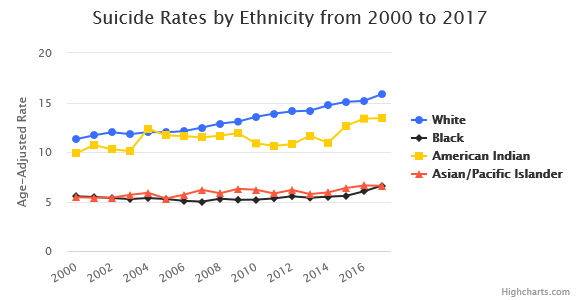
USA Today’s story, which was published earlier in the week, came with this stark headline: Suicide Rate for Native American Women is up 139%. Native American and Alaska Natives have a suicide rate 3.5 times higher than the lowest group – an astonishingly high number.

The story highlights a very, very ugly truth: In mental health – just like in health care generally speaking, unfortunately – minority communities have it worse. But, in the case of suicides, not every minority community is this way. For example, suicide rates among African Americans and Pacific Islanders have increased, but remain roughly half the rate of suicides as whites, according to the American Foundation for Suicide Prevention:

suicideRatesByEthnicity.png

Meanwhile, according to the Suicide Prevention Resource Center, rates of suicides among Hispanics also remain far below the United States average, with Hispanics dying by suicide at a rate of slightly more than half of the rest of the United States population.

This is good news, of course, and a very rare bit of good news when it comes to health care for black and Hispanic communities. What drives these rates lower? There are many theories, primarily the idea that strong family and community support provide a degree of resilience not available in other cultures, as well as the idea that self esteem and religiosity rates are higher among African Americans.

All of these factors may tie into why other minority groups have higher rates of suicide. LGBT community members are three times more likely to die by suicide. On average, LGBT members as well as Native Americans, have lower levels of self esteem, community support and family bonds.

In total: The minority suicide rates are not what they would reflexively seem to be. That’s something for all of us to keep in mind as we deal with public policy and suicide.

Why you should take Mental Health First Aid

I’ve been over the numbers more times than I care to think about: Roughly one in five Americans actively suffer from some sort of mental illness. Statistically speaking, every time you are in a room with five people, at least one of them is in the middle of some sort of mental health challenge.

That, in my mind, means all of us have to do a better job of being able to help care for our friends who are in pain or undergoing an acute mental health crisis. I’d argue to also means you should investigate taking a Mental Health First Aid class.

What is Mental Health First Aid?

Mental Health First Aid is a formal program, run by the National Council for Behavioral Health. According to its website, Mental Health First Aid “teaches you how to identify, understand and respond to signs of mental illnesses and substance use disorders in your community.”

The website wants to make Mental Health First Aid “as common as CPR.” And that’s a great idea, and a necessary one.

What does the course involve?

Per the website, Mental Health First Aid will teach participants “risk factors and warning signs for mental health and addiction concerns, strategies for how to help someone in both crisis and non-crisis situations, and where to turn for help.”

Mental Health First Aid covers a variety of topics, including depression, anxiety, trauma, psychosis and substance abuse orders, and how you, as a normal person, can help someone who is experiencing some sort of mental illness.

There are actually different course types for adults and youth, which can be very helpful for young people who want to learn how to do more.

Who should take it?

Anyone who interacts with people!

Yeah, okay, that might be a little broad. Narrowing the range a bit, I’d argue that this course should be taken by anyone who regularly interacts with people that may be experiencing some sort of mental health crisis. This includes social workers, teachers. customer service representatives and more.

Of course, it goes beyond that. If you have family or friends who suffer, and often find yourself feeling completely powerless, this course can help you learn the skills necessary to help your loved ones get through whatever they are experiencing.

Where can I find a course?

How convenient!

The course isn’t a small commitment – it’s usually around eight hours, so it requires some time. That being said, is it worth it? Yeah, I think so. All of us probably know what it’s like to have a friend who is in agony that we can’t touch. Mental Health First Aid can help people learn the tools necessary to get their friend or family member through that hard moment. For those of us who hate that helpless sensation, this can be a useful tool that will give us the power and skills to care. If that’s something you’re interested in, I’d say this is well worth it.